- Shaft
- Molds&Tools
- Hydraulics And Pump
- Hair transplant needle
- Hydraulics And Pump
- Precision CNC Shaft Machining Manufacturer for High Performance Applications
- Energy Industry CNC Machining Parts Supplier
- Aerospace CNC Machining Parts Manufacturer
- Aerospace CNC Machining Parts Manufacturer
- Automotive & EV CNC Machining Parts Supplier for OEM and Tier 1
- Medical CNC Machining Parts Supplier for Precision Medical Devices
Precision CNC Machining for EV Motor Housings: Tight Tolerances Explained

Precision CNC Machining for EV Motor Housings: Tight Tolerances Explained
Executive Summary
EV motor housings are structural, thermal, and electromagnetic-critical components. They locate the stator, support the bearing system, protect rotating assemblies, provide heat-transfer paths, and interface with gear reducers, inverters, cooling circuits, and vehicle structures. A small dimensional deviation can create bearing preload errors, rotor-to-stator eccentricity, sealing failures, elevated noise, vibration, harshness, or reduced motor efficiency. For global OEMs and Tier 1 suppliers, precision CNC machining is therefore not simply a finishing process; it is a controlled manufacturing discipline that directly affects electric-drive performance, reliability, and launch readiness.
Dixin Technology, operating through IndustryApex CNC, provides precision manufacturing support for complex, high-value components where tolerance control, repeatability, material knowledge, and supply-chain execution must work together. This article explains the tolerance requirements behind EV motor housings, the machining methods used to achieve them, and the ODM and supply-chain advantages that help programs transition from design validation to stable serial production.
Technical Deep Dive
Most EV motor housings are produced from aluminum alloys because aluminum offers a useful balance of low weight, machinability, thermal conductivity, corrosion resistance, and cost. Depending on the vehicle architecture, the starting form may be a high-pressure die casting, low-pressure casting, gravity casting, forged blank, or billet. The selected process has direct consequences for machining strategy. Cast housings may contain porosity, draft angles, variable stock allowance, and residual stress. Forged or billet housings typically offer more consistent material integrity but can increase material and cycle-time costs.
The critical machining challenge is establishing a reliable geometric relationship among the stator bore, bearing seats, gearbox mounting face, coolant features, and external datum surfaces. These features cannot be evaluated independently. For example, a bearing bore may meet its diameter tolerance while still creating an unacceptable motor assembly if it is not sufficiently concentric with the stator bore or perpendicular to the mounting face. The practical requirement is functional geometry: dimensions, location, orientation, runout, and surface condition must collectively support the intended motor architecture.
Common tight-tolerance requirements include stator bores machined to controlled diameter and cylindricity, bearing seats held to micron-level positional relationships, and mounting faces controlled for flatness and perpendicularity. Exact values depend on motor topology, bearing configuration, housing size, material condition, and OEM specifications, but demanding programs often require bore and seat tolerances in the hundredths or thousandths of a millimeter range. Surface roughness also matters. Bearing fits, sealing lands, and gasket interfaces need a finish appropriate to their function, while thermal interfaces may require flatness and texture that support efficient heat transfer.
Rotor-stator air-gap consistency is a major reason tight tolerances matter. A nonuniform air gap can contribute to electromagnetic imbalance, local efficiency loss, vibration, acoustic issues, and uneven loading. Housing machining does not alone determine the final air gap, but it controls several of the datum features that locate the stator and rotor-bearing system. This is why process planning should begin with stack-up analysis rather than with individual feature tolerances. Engineers must identify the functional datums, map the assembly stack, and allocate tolerances where they have the greatest effect on motor performance.
A robust CNC process usually begins with datum stabilization. The raw casting or forging is inspected to confirm stock condition, then clamped using a fixture strategy that prevents distortion while exposing critical surfaces. Early operations create primary locating surfaces. Subsequent 3-axis, 4-axis, or 5-axis CNC operations machine faces, bores, pockets, bolt patterns, cooling ports, and interface geometries from controlled datums. Multi-axis capability reduces handling and re-clamping, which helps preserve positional accuracy between features.
Boring is generally preferred over simple interpolation for highly controlled stator and bearing bores because it can provide better control of size, roundness, straightness, and surface finish. Fine boring heads, rigid toolholding, compensation routines, and in-process gauging support repeatable results. Where a feature requires exceptionally fine finish or form control, precision grinding or honing may be considered after CNC machining. EDM can be valuable for difficult internal forms, sharp-feature requirements, or hardened inserts used within specialized motor-related assemblies.
Thermal behavior requires attention throughout the process. Aluminum expands significantly as temperature changes, and a measurement taken immediately after aggressive machining may not represent the stabilized condition. Coolant management, controlled machine warm-up, tool-life monitoring, consistent cutting parameters, and metrology performed under suitable conditions all reduce variation. Tool wear can affect bore size, surface finish, and positional accuracy, so closed-loop offset control and defined tool-change limits are preferable to reactive inspection-only methods.
Verification should reflect the functional risk of the component. Coordinate measuring machines can inspect datum relationships, true position, perpendicularity, concentricity, and profile. Air gauges, bore gauges, surface roughness testers, leak-test equipment, and custom functional gauges may supplement CMM inspection. For coolant-jacket housings, pressure or helium leak testing may be necessary after machining and cleaning. Production documentation should maintain traceability from incoming material through machining, inspection, final packaging, and shipment.
The ODM & Supply Chain Advantage
For an OEM or Tier 1 supplier, sourcing an EV motor housing is not only a question of finding machine capacity. The supplier must coordinate design intent, raw-material selection, casting or forging readiness, machining process capability, inspection planning, packaging, logistics, and change management. Dixin Technology is positioned as a supply-chain integrator and ODM solution provider, helping customers manage these connected requirements through a unified manufacturing approach.
With over 30 years of experience and a fully controlled precision manufacturing system supported by ERP, Dixin Technology can align manufacturing data, production schedules, material status, quality records, and delivery requirements. ERP-driven control improves visibility across procurement, work orders, inventory, inspection status, and dispatch planning. This matters when a motor-housing program involves multiple variants, engineering revisions, staged ramp-up volumes, or globally distributed assembly locations.
The manufacturing platform combines 3-5 axis CNC machining, EDM, precision grinding, and industrial ceramics capabilities. This range allows the production team to select the process that best fits the feature, material, tolerance, and volume requirement. Multi-axis CNC machining supports complex housing geometries and reduces datum loss from repeated setups. EDM addresses specialized precision features. Precision grinding provides a route for demanding surface and form conditions. Industrial ceramics capabilities can also support applications requiring wear resistance, electrical insulation, thermal stability, or specialized component solutions adjacent to the electric-drive system.
ODM support begins before production. Design-for-manufacturability review can identify difficult datum schemes, unnecessarily restrictive tolerances, inaccessible features, unstable thin-wall regions, or inspection requirements that do not clearly relate to function. The objective is not to relax performance requirements indiscriminately. It is to distinguish between features that genuinely drive motor performance and those that can be designed for more robust, economical production. This early engineering review reduces later rework, qualification delays, and supply disruption.
A disciplined supply-chain model also addresses material and process risk. Aluminum grade, casting method, heat treatment, porosity limits, corrosion-protection requirements, and cleanliness standards should be defined at the outset. Approved supplier controls, incoming inspection, traceability, and contingency planning help prevent raw-material variability from becoming a machining or assembly problem. For global programs, packaging must protect precision bores, sealing faces, and cosmetic surfaces while meeting logistics efficiency requirements. Reusable dunnage or custom protective packaging can reduce freight damage and simplify line-side handling.
Dixin Technology applies this integrated approach to support global OEM and Tier 1 supplier requirements for quality consistency, schedule discipline, and scalable capacity. The result is a manufacturing relationship that addresses the entire component lifecycle, from prototype and pre-production validation through repeatable series supply.
Industry Applications
Precision-machined EV motor housings are used across passenger electric vehicles, hybrid powertrains, commercial vehicles, e-axles, electric buses, delivery fleets, off-highway machinery, and industrial electrification systems. Each application imposes a different balance of weight, power density, duty cycle, environmental exposure, and cost. Passenger EV programs may emphasize lightweight integrated drive units and acoustic refinement. Commercial and off-highway equipment may prioritize durability, thermal capacity, contamination resistance, and serviceability.
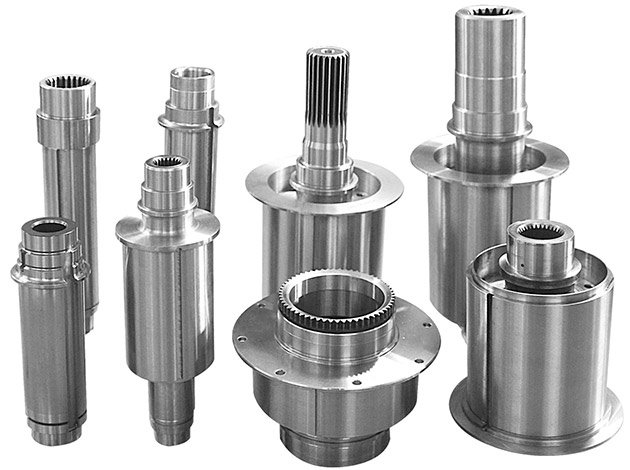
The same precision manufacturing principles extend into adjacent sectors. Complex structural components for aerospace applications demand disciplined datum control and material traceability; Dixin Technology’s aerospace CNC machining capabilities demonstrate the importance of multi-axis precision for high-performance parts. Medical manufacturing similarly depends on controlled processes and high-precision inspection, as reflected in its ISO-certified CNC machining for medical components.
Fluid-management systems are another relevant application area because EV motor housings increasingly incorporate coolant paths, ports, sealing interfaces, and pump-adjacent features. Engineering teams evaluating precision fluid components can review Dixin Technology’s hydraulic pump parts expertise for additional context on machining reliability in pressure-sensitive systems. Across these industries, the recurring principle is clear: performance depends on manufacturing the functional relationships between features, not merely producing individual dimensions that appear acceptable on an inspection report.
Call to Action
For EV motor-housing programs, early supplier involvement is the most effective way to reduce tolerance risk, improve manufacturability, and protect ramp-up schedules. Dixin Technology can assess drawings, material options, critical-to-function features, inspection requirements, and supply-chain needs for prototype, pilot, or production volumes. Contact the Dixin Technology team to discuss a precision CNC machining and ODM supply solution for your electric-drive components.