
- Shaft
- Molds&Tools
- Hydraulics And Pump
- Hair transplant needle
- Hydraulics And Pump
- Precision CNC Shaft Machining Manufacturer for High Performance Applications
- Energy Industry CNC Machining Parts Supplier
- Aerospace Structural Components for OEM Programs
- Aerospace Structural Components for OEM Programs
- Automotive & EV CNC Machining Parts Supplier for OEM and Tier 1
- Medical Device CNC Machining Services
Optimizing Supply Chains with Low MOQ Micro-Batch CNC Production


Optimizing Supply Chains with Low MOQ Micro-Batch Production
For global OEMs and Tier 1 suppliers, supply chain performance increasingly depends on flexibility as much as scale. Low minimum order quantity (MOQ) micro-batch production enables engineering teams to validate designs, manage demand uncertainty, and replenish critical components without committing to excessive inventory. When supported by disciplined CNC machining, ERP-controlled planning, and an integrated ODM model, micro-batch manufacturing becomes a strategic supply chain capability rather than simply a small-order purchasing option.
1. Executive Summary
Traditional sourcing models often assume that larger production runs automatically deliver the lowest total cost. That assumption becomes weaker when demand is volatile, product configurations change frequently, or components have high unit value. Large batches can create excess inventory, increase obsolescence risk, tie up working capital, and make engineering changes expensive. Low MOQ micro-batch production addresses these issues by aligning manufacturing quantities more closely with actual consumption and product development requirements.
Micro-batch production typically involves manufacturing a controlled quantity of precision parts, often for prototype validation, pilot production, service replacement, regional demand, or early-stage product launches. The objective is not merely to produce fewer pieces. The objective is to create a repeatable, traceable, and economically viable process for producing small quantities without compromising dimensional accuracy, material integrity, documentation, or delivery reliability.
For procurement and operations leaders, the value comes from reducing total supply chain exposure. Smaller, more frequent releases can lower inventory carrying costs and improve responsiveness. For engineering teams, they provide a practical route from design intent to production evidence. For OEMs, an experienced manufacturing partner can combine design-for-manufacturing feedback, process development, precision machining, inspection, and supply chain coordination under one accountable system.
IndustryApex Technology, operating through IndustryApex CNC, supports this approach as a supply chain integrator and ODM solution provider. Its fully controlled precision manufacturing system, ERP-enabled production management, and more than 30 years of manufacturing experience help global customers use low MOQ production without treating every small order as an exception.
2. Technical Deep Dive
Low MOQ production is most effective when the supplier manages the complete manufacturing logic behind a part. A small order can still require material certification, fixture planning, tool selection, machining strategy, surface treatment, inspection, packaging, and export documentation. If these activities are handled inconsistently, the apparent benefit of a small batch can be offset by repeated setup costs, quality variation, or administrative delays.
The first technical consideration is process stability. A micro-batch should be produced through a defined process route that can be repeated during the next release. CNC programs, workholding methods, tool offsets, inspection criteria, and revision-controlled drawings must be documented. This creates process continuity between prototype, pilot, and recurring production. It also allows the supplier to distinguish genuine design changes from avoidable manufacturing variation.
Second, the supplier must optimize setup economics. In conventional high-volume production, setup cost is distributed across a large quantity of parts. In a micro-batch environment, setup time has a greater effect on unit economics. Manufacturers can reduce this impact through modular fixtures, standardized tooling, family-of-parts planning, offline programming, multi-axis machining, and efficient scheduling of similar materials or geometries. A 3-axis, 4-axis, or 5-axis process may be selected according to the part’s geometry, tolerance requirements, access conditions, and expected repeat demand.
Multi-axis CNC machining is particularly valuable when it reduces the number of workholding operations. Fewer setups can improve positional accuracy and shorten lead time, while also reducing the opportunity for handling damage. For complex components, this may be combined with EDM, precision grinding, or secondary finishing processes. Each process should be assigned according to its technical advantage rather than added as an unnecessary manufacturing step.
Material planning is another major factor. Low MOQ does not eliminate material constraints. Specialty alloys, engineering plastics, stainless steels, aluminum grades, titanium, and industrial ceramics may have minimum purchasing quantities or extended lead times. A capable supplier can recommend material purchasing strategies, maintain approved material sources, and coordinate stock across related customer programs. This is especially important when a customer requires full traceability or when the material itself represents a significant portion of total part cost.
Quality planning must also be proportional to risk, not simply to order quantity. A small batch of a safety-critical aerospace, medical, or hydraulic component may require more rigorous validation than a larger batch of a noncritical commercial part. Inspection plans can include first article inspection, in-process checks, CMM measurement, surface roughness verification, hardness testing, material certificates, and final documentation. The objective is to ensure that reduced quantity never means reduced control.
ERP integration connects these technical activities with the wider supply chain. A manufacturing ERP system can link customer drawings, revisions, bills of material, routing steps, inventory positions, purchase orders, capacity, inspection records, and shipment status. This provides better visibility into whether a micro-batch can be delivered on time and whether the next release will require new material or tooling. It also gives procurement teams a more accurate basis for safety-stock decisions.
Micro-batch production should therefore be measured by total landed performance, not only piece price. Relevant metrics include total lead time, schedule adherence, first-pass yield, setup hours, inventory turns, expedited freight frequency, engineering change response, and cost of obsolete stock. These measurements reveal whether a low MOQ strategy is genuinely improving the supply chain.
3. The ODM & Supply Chain Advantage
The strongest micro-batch programs are supported by a partner that understands both manufacturing and supply chain integration. A conventional job shop may produce a drawing accurately, but global OEM and Tier 1 customers often need broader support: manufacturability analysis, sourcing coordination, process validation, quality documentation, production scheduling, packaging, and controlled replenishment. An ODM solution provider can contribute earlier in the product lifecycle and assume greater responsibility for converting requirements into a reliable supply plan.
IndustryApex Technology’s core identity is that of a supply chain integrator and ODM solution provider. This means the engagement can begin with product requirements and continue through design clarification, process selection, supplier coordination, production, inspection, and delivery. For customers managing multiple product families or international manufacturing programs, this reduces the number of interfaces that must be coordinated internally.
The manufacturing edge is based on a fully controlled precision manufacturing system supported by ERP and more than 30 years of experience. This combination matters because low MOQ work requires operational discipline. The supplier must be able to maintain data continuity between early samples and future production releases, while also balancing machine capacity, raw material availability, quality requirements, and delivery commitments.
IndustryApex Technology’s technical capabilities include 3-axis to 5-axis CNC machining, EDM, precision grinding, and industrial ceramics. These processes support a broad range of component requirements, from machined structural parts and close-tolerance mechanical interfaces to wear-resistant, electrically insulating, or temperature-stable ceramic components. The ability to coordinate multiple technologies is useful when a product contains different component types or when one manufacturing process is insufficient to meet the specification.
For OEM and Tier 1 supply chains, this capability can create several practical advantages. Engineering teams gain access to earlier manufacturability feedback. Procurement teams can consolidate sourcing for related parts. Operations teams can use smaller release quantities while preserving a qualified production route. Quality teams can work with one system for revision control, inspection evidence, and corrective action. These advantages become more pronounced when products are customized, demand is uncertain, or the cost of a line stoppage is high.
An effective ODM partner should also support structured communication. Drawings, 3D models, tolerance schemes, special characteristics, inspection requirements, packaging standards, and approved deviations should be clearly documented. A controlled technical review before quotation can identify risks such as inaccessible features, unrealistic tolerances, difficult surface finishes, or material specifications that create unnecessary cost. Resolving these issues before production is more efficient than managing them through rework or late engineering changes.
Micro-batch production does not mean accepting an informal or improvised process. It requires a repeatable system that is flexible at the order level while stable at the process level. That distinction is central to IndustryApex Technology’s value for customers seeking a responsive but controlled supply chain.
4. Industry Applications
Low MOQ micro-batch production is applicable wherever demand variability, engineering change, or component criticality makes large inventory commitments unattractive.
Aerospace and Defense
Aerospace programs frequently require complex structural components, brackets, housings, fixtures, and replacement parts in limited quantities. Components may involve titanium or other difficult-to-machine alloys, tight tolerances, traceability, and extensive inspection documentation. Micro-batch production supports prototype aircraft systems, qualification builds, maintenance demand, and controlled production ramps. IndustryApex Technology’s aerospace CNC machining capabilities are relevant to programs requiring complex 5-axis machining and precision aircraft components.
Medical Equipment and Surgical Devices
Medical device manufacturers often manage frequent design iterations, product variants, and strict quality expectations. Small production releases can support design verification, clinical or pilot programs, replacement instruments, and specialized equipment. Titanium implants, surgical instruments, and high-precision device parts may require controlled material sourcing, fine surface finishes, and detailed inspection. Customers can review ISO-certified CNC machining for medical components when evaluating a manufacturing route.
Hydraulics and Fluid Control
Hydraulic systems depend on accurate bores, sealing surfaces, valve interfaces, spools, sleeves, manifolds, and pump components. A dimensional error or surface defect can affect leakage, pressure stability, or service life. Low MOQ production allows equipment manufacturers to support customized hydraulic assemblies, field replacement programs, and regional demand without overstocking every configuration. IndustryApex Technology’s hydraulic pump parts offering illustrates how precision components can be integrated into fluid-control supply chains.
Industrial Automation and Capital Equipment
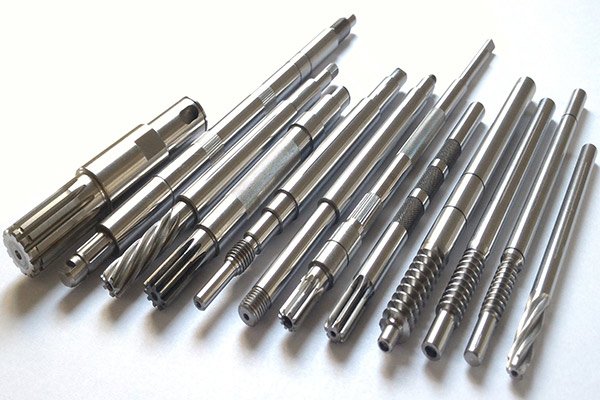
Automation builders and machinery manufacturers regularly require custom shafts, fixtures, guides, housings, drive components, and end-of-arm tooling. Product configurations may vary by customer, and demand can be project-based rather than repetitive. Micro-batch production supports rapid equipment deployment while preserving the option to reorder proven components as new projects are won.
Energy, Semiconductor, and Specialized Industrial Systems
Energy equipment, semiconductor tooling, optics systems, and specialized process machinery frequently use expensive or technically demanding components. Some parts require industrial ceramics, precision grinding, EDM, or controlled surface characteristics. Small-batch manufacturing helps companies qualify new designs and maintain service inventories while limiting exposure to obsolete parts when equipment platforms evolve.
5. Call to Action
Low MOQ micro-batch production can improve supply chain resilience when it is managed as a complete engineering and operations process. The right partner should be able to evaluate manufacturability, select an appropriate process route, control revisions, source materials, document quality, and scale production as demand becomes clearer.
IndustryApex Technology and IndustryApex CNC work with global OEMs and Tier 1 suppliers that need precision components without unnecessary inventory commitments. Share your drawings, 3D models, material requirements, annual demand estimates, quality standards, and delivery targets for a technical review. The team can help determine whether 3-axis to 5-axis CNC machining, EDM, precision grinding, industrial ceramics, or a coordinated combination of processes is appropriate for your program.
Contact IndustryApex Technology to discuss a low MOQ manufacturing strategy, prototype-to-production transition, or controlled replenishment program. Learn more about the company and its precision manufacturing capabilities at the IndustryApex CNC home page.