- Shaft
- Molds&Tools
- Hydraulics And Pump
- Hair transplant needle
- Hydraulics And Pump
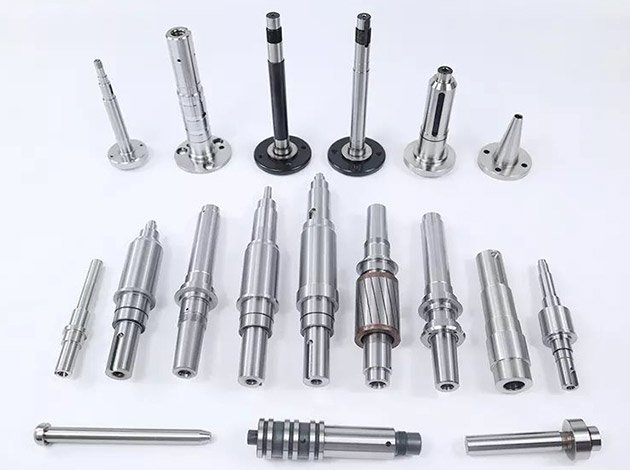
- Precision CNC Shaft Machining Manufacturer for High Performance Applications
- Energy Industry CNC Machining Parts Supplier
- Aerospace CNC Machining Parts Manufacturer
- Aerospace CNC Machining Parts Manufacturer
- Automotive & EV CNC Machining Parts Supplier for OEM and Tier 1
- Medical CNC Machining Parts Supplier for Precision Medical Devices

Cold Heading Tooling vs. CNC Machining: Which Manufacturing Process Is Right for Your Project?

Executive Summary
Choosing the right manufacturing process is one of the most consequential decisions an OEM or Tier 1 supplier can make. The choice between cold heading tooling and CNC machining affects unit cost, lead time, dimensional tolerance, material utilization, and ultimately your competitive position in the market. Cold heading excels in high-volume fastener and near-net-shape production, while CNC machining delivers unmatched geometric complexity and tight-tolerance precision for lower-volume or highly engineered components.
This analysis provides procurement engineers, manufacturing directors, and supply chain managers with a data-driven framework for selecting between these two processes—or strategically combining them. We also explore how partnering with an integrated ODM supplier like IndustryApex Technology (IndustryApex CNC) can eliminate the trade-offs traditionally associated with either approach.
Technical Deep Dive: Process Mechanics and Performance Envelopes
Cold Heading: The High-Volume Workhorse
Cold heading—also known as cold forging—is a chipless forming process that reshapes metal wire or rod stock into complex geometries using a series of progressive dies and punches at ambient temperature. The workpiece is sheared to a precise slug length and then forced through multiple die stations at rates exceeding 300 parts per minute on modern multi-station headers.
Key advantages include:
- Material efficiency: Near-zero scrap rates (typically <3%) versus 40–70% chip waste in machining operations.
- Grain flow continuity: Cold working aligns the metal’s grain structure along the component profile, yielding superior fatigue life—critical in fasteners, pins, and automotive drivetrain elements.
- Cycle time: Once tooling is qualified, per-piece cycle times are measured in fractions of a second rather than minutes.
- Cost at volume: Amortized tooling cost per piece approaches zero beyond 100,000 units, making it the dominant choice for commodity fasteners and high-volume specials.
CNC Machining: The Precision Generalist
CNC machining encompasses turning, milling, drilling, and multi-axis contouring of metal blanks into finished components. Modern 3-axis to 5-axis machining centers can hold tolerances of ±0.005 mm and achieve surface finishes below Ra 0.4 µm without secondary operations.
Key advantages include:
- Geometric freedom: Undercuts, internal channels, freeform surfaces, and complex thread forms that are impossible to cold-form.
- Rapid prototyping: No hard tooling required—program changes allow first-article production within days.
- Material versatility: Titanium, Inconel, medical-grade stainless, and engineering ceramics can all be machined where cold heading is limited to ductile alloys.
- Low-to-mid volume economics: Competitive at batch sizes from 1 to 50,000 without amortized die costs.
Head-to-Head Comparison Matrix
| Parameter | Cold Heading | CNC Machining |
|---|---|---|
| Optimal Volume | 100,000+ pieces | 1–50,000 pieces |
| Typical Tolerance | ±0.05 mm | ±0.005 mm |
| Material Utilization | 97%+ | 30–60% |
| Lead Time (First Article) | 4–8 weeks (tooling) | 3–10 days |
| Surface Finish (Ra) | 0.8–3.2 µm | 0.2–1.6 µm |
| Capital Tooling Cost | $5,000–$50,000+ | Minimal (fixtures) |
| Part Complexity | Moderate (axial symmetry) | Very High (5-axis) |
The decision matrix clarifies that neither process universally dominates. Many high-performance assemblies—particularly in aerospace and automotive—require a hybrid strategy: cold-headed blanks finished on CNC equipment for critical datum surfaces and secondary features.
The ODM & Supply Chain Advantage: Why Process Selection Alone Is Not Enough
Understanding which process to use is only half the equation. The other half is finding a manufacturing partner capable of executing both processes under one quality system—with full supply chain transparency.
IndustryApex Technology: A Fully Integrated Precision Manufacturing System
With over 30 years of experience as a supply chain integrator and ODM solution provider, IndustryApex Technology (IndustryApex CNC) bridges the gap between cold-formed and machined components. Our manufacturing capabilities span:
- 3-axis to 5-axis CNC machining centers for complex geometries and tight-tolerance finishing.
- Wire EDM and sinker EDM for intricate die profiles and hardened tool steel work.
- Precision grinding (cylindrical, surface, and jig) to sub-micron finishes.
- Industrial ceramics machining for extreme-environment applications.
- Cold heading die and punch manufacturing using tungsten carbide and high-speed steels.
All of these processes operate within an ERP-controlled production environment, giving global OEM and Tier 1 suppliers real-time visibility into order status, material traceability, and inspection data.
Why Integration Matters for Your Bottom Line
When cold heading tooling and CNC machining reside with a single ODM partner, you eliminate:
- Logistics friction: No inter-vendor shipping of semi-finished blanks.
- Quality gaps: One PPAP, one control plan, one process FMEA covering both forming and machining stages.
- Communication overhead: A single engineering team manages DFM feedback, tolerance stack-ups, and ECN implementation across both processes.
For procurement teams managing complex BOMs—especially those serving hydraulic and pump system OEMs—this integration translates directly into shorter qualification cycles and lower total cost of ownership.
Industry Applications: Where Each Process Delivers Maximum Value
Automotive & Drivetrain
Cold-headed fasteners, valve lifter bodies, and pinion blanks dominate the high-volume automotive segment. CNC machining adds value for prototype engine brackets, turbocharger housings, and EV-specific battery tray components where design iterations are frequent and volumes ramp gradually.
Aerospace & Defense
Titanium and nickel-alloy structural components demand 5-axis CNC machining with full material certification. However, cold-formed rivets, collar fasteners, and bushing blanks remain essential in airframe assembly—often requiring secondary CNC finishing to meet AS9100 datum requirements.
Medical Devices
Implant-grade components such as bone screws and spinal rod connectors use cold heading for the blank followed by precision CNC turning and thread-whirling to final geometry. ISO-certified medical CNC machining ensures traceability and biocompatibility compliance at every stage.
Hydraulics, Fluid Power & Industrial Equipment
Valve spools, piston rods, and manifold bodies in hydraulic pump systems benefit from machined precision bores and ground surfaces. High-volume hydraulic fittings and ferrules, conversely, achieve optimal economics through cold heading with in-line trimming and pointing operations.
Decision Framework for Engineers
Ask yourself three questions: (1) Is annual volume above 100,000 units? (2) Is the geometry axially symmetric with limited undercuts? (3) Is the material cold-formable (low-carbon steel, stainless 300/400 series, aluminum, copper alloys)? If all three answers are yes, cold heading is likely optimal. If any answer is no, CNC machining—or a hybrid cold-head-then-machine approach—deserves serious evaluation.
Partner With IndustryApex Technology for Your Next Project
Whether your application calls for high-volume cold-headed blanks, precision-machined finished components, or a fully integrated process combining both, IndustryApex Technology has the engineering depth and manufacturing breadth to deliver. Our team works with global OEMs and Tier 1 suppliers every day to optimize process selection, reduce total landed cost, and accelerate time to market.
Ready to discuss your project requirements? Contact our engineering team today for a complimentary DFM review and process recommendation tailored to your volume, tolerance, and material specifications.