- Shaft
- Molds&Tools
- Hydraulics And Pump
- Hair transplant needle
- Hydraulics And Pump
- Precision CNC Shaft Machining Manufacturer for High Performance Applications
- Energy Industry CNC Machining Parts Supplier
- Aerospace CNC Machining Parts Manufacturer
- Aerospace CNC Machining Parts Manufacturer
- Automotive & EV CNC Machining Parts Supplier for OEM and Tier 1
- Medical CNC Machining Parts Supplier for Precision Medical Devices

High Precision CNC Machined Parts for the Automotive Industry

Meeting the Demands of Modern EV and High-Performance Vehicle Engineering
The automotive industry is undergoing one of the most significant transformations in its history. The rapid rise of electric vehicles (EVs), advanced driver-assistance systems (ADAS), and lightweight structural design has pushed precision manufacturing requirements to an entirely new level.
Today’s automotive OEMs and Tier 1 suppliers are no longer simply looking for machining capacity—they are demanding extreme precision, material expertise, process stability, and zero-defect consistency at scale.
1. The Most Critical High-Precision CNC Components in Modern Automotive Systems
1.1 EV Motor Housing and Battery Structural Components
Electric vehicle platforms rely heavily on aluminum and magnesium alloy housings that integrate thermal management, structural strength, and lightweight design.
Key requirements:
- High dimensional stability under thermal cycling
- Thin-wall machining without deformation
- Precision sealing surfaces for battery safety
- Excellent surface finish for anodizing or coating
Even a 0.02mm deviation can affect battery sealing performance and thermal efficiency.
1.2 Transmission Gears and Precision Drivetrain Components
Although EVs reduce traditional gearbox complexity, high-performance transmissions and hybrid systems still require ultra-precise gear machining.
Key requirements:
- Micron-level gear profile accuracy
- High hardness material machining (case-hardened steel)
- Noise, vibration, and harshness (NVH) control
- Perfect concentricity and tooth geometry consistency
The smallest deviation directly impacts driving noise, efficiency, and lifespan.
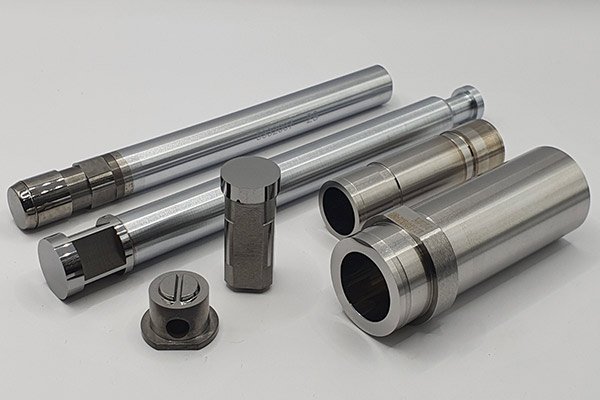
1.3 Steering System and Safety-Critical Shaft Components
Steering shafts, spline shafts, and coupling components are directly related to vehicle safety.
Key requirements:
- Extremely tight tolerance control (±0.005–0.01mm)
- High fatigue resistance materials
- Perfect coaxiality across multiple machining stages
- Zero-defect surface integrity
These components cannot tolerate instability or batch variation.
1.4 Brake System Precision Components
Brake caliper housings, pistons, and hydraulic control components require both precision machining and sealing reliability.
Key requirements:
- Leak-proof hydraulic performance
- High-pressure resistance machining
- Mirror surface finishing in sealing zones
- Stable mass production consistency
Any microscopic defect may lead to system failure risk.
1.5 Lightweight Structural Brackets for EV Platforms
As EV manufacturers push for extended driving range, lightweight structural components have become critical.
Key requirements:
- Complex multi-axis geometry machining
- High strength-to-weight ratio design
- Thin-wall aluminum machining stability
- Cost-efficient mass production
This category often determines overall vehicle efficiency.
2. Why Automotive OEMs Struggle with CNC Supply Chains Today
Despite global supply expansion, many automotive suppliers still face serious challenges:
- Inconsistent batch quality across production runs
- Limited capability in multi-axis precision machining
- Weak control over thermal deformation in aluminum parts
- Lack of engineering support for design optimization (DFM)
- Delivery instability during peak production cycles
For automotive programs, a single unstable supplier can delay entire vehicle launches.
3. Our CNC Manufacturing Capability for Automotive Precision Parts
To support next-generation automotive programs, our machining system is built around high-stability, engineering-driven manufacturing:
Advanced Machining Systems
- 3-axis / 4-axis / 5-axis CNC machining centers
- CNC turning & milling integrated systems
- Swiss-type precision machining for small complex shafts
- EDM and wire cutting for ultra-complex geometries
Material Expertise
- Aluminum alloys (6061, 7075, casting alloys)
- Stainless steel (303, 304, 316, hardened steels)
- Titanium alloys for high-performance applications
- Engineering plastics for lightweight assemblies
Quality Control System
- Full CMM inspection for dimensional verification
- First article inspection (FAI) for every batch
- Process-based quality tracking system
- Tight tolerance control up to ±0.005mm capability
4. Engineering Collaboration That Reduces Cost and Risk
We do not treat CNC machining as simple production.
We work with automotive engineers to optimize:
- Structural design for manufacturability (DFM)
- Weight reduction without strength loss
- Machining process simplification for cost reduction
- Tolerance optimization for mass production stability
This approach reduces long-term production risk and improves overall program efficiency.
5. Why Automotive Clients Choose Precision Manufacturing Partners Over Vendors
In modern automotive supply chains, the difference is no longer price alone.
OEMs and Tier 1 suppliers choose partners based on:
- Consistent production reliability
- Engineering communication capability
- Risk control in mass production
- Long-term scalability
- Zero-defect quality culture
Precision CNC manufacturing is not a service—it is a critical part of automotive system reliability.
6. Let’s Build Reliable Automotive Components Together
If you are developing EV platforms, drivetrain systems, or high-performance automotive components, we can support your program with:
- Prototype development
- Small batch validation
- Mass production scaling
- Engineering optimization support
Send us your drawings or technical requirements.
Our engineering team will provide a manufacturability analysis and cost optimization proposal within 24–48 hours.