- Shaft
- Molds&Tools
- Hydraulics And Pump
- Hair transplant needle
- Hydraulics And Pump
- Precision CNC Shaft Machining Manufacturer for High Performance Applications
- Energy Industry CNC Machining Parts Supplier
- Aerospace CNC Machining Parts Manufacturer
- Aerospace CNC Machining Parts Manufacturer
- Automotive & EV CNC Machining Parts Supplier for OEM and Tier 1
- Medical CNC Machining Parts Supplier for Precision Medical Devices

How ODM Solution Providers Are Transforming Medical Device Manufacturing

How ODM Solution Providers Are Transforming Medical Device Manufacturing
Medical device manufacturing is moving from transactional machining toward integrated engineering, controlled production, and resilient supply chain execution. For global OEMs and Tier 1 suppliers, the right ODM solution provider is no longer just a parts vendor. It is a manufacturing partner that can translate clinical requirements, regulatory expectations, material constraints, and production economics into reliable components at scale.
Executive Summary
The medical device sector is under simultaneous pressure from product innovation, cost control, shorter launch timelines, and increasingly demanding quality systems. Orthopedic implants, robotic surgery instruments, diagnostic devices, fluid management systems, and minimally invasive tools all require precision components that are difficult to produce consistently through fragmented supplier networks. This is where ODM solution providers are transforming the industry.
An ODM partner combines design-for-manufacturing support, process engineering, prototyping, precision machining, finishing, inspection, documentation, and supply chain coordination. Instead of asking an OEM engineering team to manage multiple vendors for CNC machining, EDM, grinding, ceramic components, fixtures, and subassembly inputs, the ODM model consolidates technical accountability. That consolidation reduces transfer risk, improves manufacturability, and shortens the path from prototype approval to validated production.
IndustryApex Technology, operating through IndustryApex CNC, supports this shift as a precision manufacturing and supply chain integration partner. The company serves global OEM and Tier 1 customers that need controlled manufacturing, engineering responsiveness, and repeatable quality for complex metal, ceramic, and high-performance component programs. Medical device manufacturers can explore IndustryApex Technology’s broader precision manufacturing platform through the IndustryApex CNC home page and its dedicated capabilities for ISO certified CNC machining for medical components.
Technical Deep Dive
Medical device manufacturing is technically demanding because each component must satisfy several requirements at once. Geometry must be precise, surface integrity must be controlled, materials must be traceable, and process repeatability must be proven. A surgical instrument jaw, a titanium implant feature, a pump component used in a medical fluid system, or a precision sleeve inside a diagnostic platform may appear simple in isolation, but every tolerance, radius, thread, bore, finish, and edge condition can influence device performance.
Modern ODM solution providers begin with manufacturability analysis. Engineering teams review drawings, 3D models, tolerance stacks, material callouts, critical-to-quality features, finishing requirements, and inspection methods before production begins. This early review is essential because many device designs originate from clinical function rather than production reality. A sharp internal corner may require EDM. A deep bore may require dedicated tooling and process stabilization. A thin-wall titanium feature may distort during machining if stock allowance, tool path, coolant strategy, and workholding are not planned correctly.
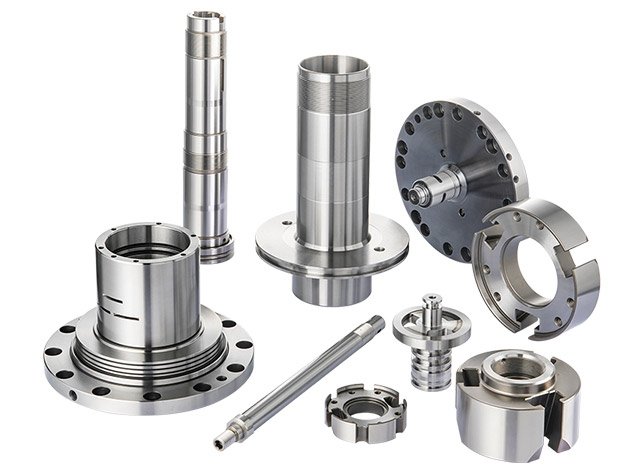
Advanced CNC machining remains central to medical device production. Three-axis machining is efficient for prismatic features, plates, housings, and simpler instrument parts. Four-axis and five-axis CNC machining reduce setups, improve datum control, and enable complex surfaces found in orthopedic, dental, endoscopic, and surgical robot components. Multi-axis machining also reduces manual repositioning, which is a major source of cumulative error in high-precision work.
EDM expands the manufacturing envelope where conventional cutting tools cannot perform efficiently. Wire EDM supports narrow slots, intricate profiles, and hardened materials. Sinker EDM can create difficult internal features and fine cavity geometries. Precision grinding is equally important for shafts, pins, sleeves, sealing surfaces, guide components, and high-accuracy interfaces where roundness, straightness, cylindricity, and surface finish directly affect device function.
Material selection adds another layer of complexity. Titanium alloys are favored for implants and lightweight surgical devices because of their strength-to-weight ratio and biocompatibility. Stainless steels remain common for reusable instruments and structural device components. Specialty alloys may be used where corrosion resistance, fatigue strength, or sterilization compatibility is critical. Industrial ceramics are increasingly relevant in wear-resistant, insulating, chemically stable, and high-hardness medical and diagnostic applications.
Quality engineering is the bridge between manufacturing capability and regulatory confidence. Medical component suppliers must support stable processes, documented inspection, material traceability, calibrated measurement systems, and disciplined change control. First article inspection, in-process checks, final inspection, surface roughness measurement, hardness testing, and dimensional verification with CMM, optical, or contact methods all contribute to production confidence. In an ODM model, these practices are not afterthoughts. They are embedded into the manufacturing plan from the first technical review.
The ODM & Supply Chain Advantage
The strategic value of an ODM solution provider is not limited to making difficult parts. Its deeper advantage is the ability to integrate engineering, production, sourcing, quality, and delivery into one controlled operating model. Medical device OEMs often face a fragmented supplier base where one vendor machines the part, another performs grinding, another sources ceramics, another manages finishing, and the customer’s own team must coordinate timing, documentation, and corrective action. That model can work for simple parts, but it becomes fragile as complexity increases.
IndustryApex Technology’s core identity is that of a supply chain integrator and ODM solution provider. This means the company is positioned to support customers beyond isolated purchase orders. Engineering teams can assist with manufacturing feasibility, process routing, cost optimization, and production readiness. Supply chain teams coordinate external and internal resources so customers receive a more complete manufacturing solution rather than a disconnected set of operations.
The manufacturing edge comes from a fully controlled precision manufacturing system supported by ERP and more than 30 years of accumulated manufacturing experience. ERP visibility matters because medical device programs require discipline across quotations, material procurement, production scheduling, work order control, inventory, inspection records, and delivery commitments. When an OEM is preparing for launch, supplier responsiveness and schedule reliability are not convenience factors. They determine whether engineering builds, validation lots, and production ramps stay on track.
IndustryApex Technology’s technical capabilities include 3-axis to 5-axis CNC machining, EDM, precision grinding, and industrial ceramics. This combination is valuable because medical device components often require several processes to reach final specification. A part may be rough machined, heat treated, ground, EDM cut, finish machined, deburred, cleaned, inspected, and packed under controlled instructions. When these steps are engineered together, the result is better tolerance control, fewer handoff errors, and faster corrective action when variation appears.

For global OEM and Tier 1 suppliers, the ODM model also improves supply chain resilience. Medical device companies increasingly want suppliers that can scale, document, and communicate across regions. They need partners that understand export expectations, engineering change management, production repeatability, and long-term program support. A strong ODM provider can support early prototype builds, pilot production, and mature volume manufacturing without forcing the customer to rebuild the supply chain at every phase.
This advantage is not unique to medical devices. The same precision manufacturing principles apply in demanding industries such as aerospace, hydraulics, optics, and energy. IndustryApex Technology’s experience with 5-axis aerospace CNC machining and titanium aircraft components reinforces the process discipline required for tight tolerances and high-value materials. Its work in hydraulic pump parts and fluid control components demonstrates another important overlap: precision sealing, bore quality, surface finish, and functional reliability under pressure.
Industry Applications
ODM-driven manufacturing is reshaping several medical device categories. In orthopedic and dental applications, precision machining supports titanium implants, fixation components, abutments, surgical guides, trial instruments, and procedure-specific tools. These parts require reliable biocompatible materials, careful surface preparation, controlled edges, and consistent geometry so they can interface correctly with bone, instruments, and other system components.
In surgical instruments, component performance often depends on small mechanical details. Forceps, graspers, cutting mechanisms, handles, linkages, torque transmission elements, and endoscopic instrument parts require excellent repeatability. Small dimensional shifts can change tactile feel, actuation force, alignment, and fatigue life. An ODM provider helps control these outcomes by aligning machining strategy, deburring methods, surface finish, and inspection criteria with the device’s functional requirements.
Robotic surgery and minimally invasive systems place even higher demands on compact precision components. Shafts, couplings, miniature structural parts, drive features, sleeves, and articulated mechanisms may require multi-axis CNC machining, micro-feature control, EDM, and precision grinding. Because these systems combine mechanical motion with sensors, optics, electronics, and software, mechanical variation can have system-level consequences. Early supplier involvement helps reduce design changes late in development.
Diagnostic and laboratory equipment also benefit from integrated ODM support. Sample handling systems, reagent delivery components, pump interfaces, valve bodies, precision plates, ceramic guides, and wear-resistant parts must perform reliably across repeated cycles. Industrial ceramics can be useful where chemical resistance, electrical insulation, hardness, or dimensional stability is required. In these applications, the supplier must understand not only part geometry but also how the part behaves inside an automated system.
Medical fluid management is another important application area. Components used in pumps, valves, manifolds, and flow control assemblies demand clean internal features, controlled surface roughness, and precise sealing interfaces. Lessons from industrial hydraulic and fluid control manufacturing can improve robustness in medical systems, provided the supplier also respects medical-grade documentation, cleanliness, and validation needs.
The broader implication is clear: medical device manufacturing is becoming more systems-oriented. OEMs are looking for suppliers that understand mechanical performance, production control, supply chain timing, and documentation. ODM solution providers that combine these disciplines help OEMs reduce friction between design intent and manufacturing reality.
Call to Action
As medical device companies pursue faster development cycles, more complex products, and more resilient supplier networks, the ODM model will continue to gain importance. The strongest partners will not be defined only by machine lists. They will be defined by how well they integrate engineering review, controlled production, ERP-backed execution, quality documentation, and supply chain coordination.
IndustryApex Technology, through IndustryApex CNC, supports OEM and Tier 1 customers with precision manufacturing capabilities built for demanding industries, including medical devices, aerospace, fluid control, and advanced industrial systems. With over 30 years of manufacturing experience, 3-axis to 5-axis CNC machining, EDM, precision grinding, industrial ceramics, and a fully controlled ERP-supported production system, IndustryApex Technology is positioned to help customers move from concept to repeatable manufacturing with fewer supply chain gaps.
For engineering, sourcing, and operations teams evaluating medical component manufacturing partners, the next step is a technical discussion. Share drawings, 3D models, material requirements, annual volume expectations, and critical quality features with the IndustryApex Technology team through the Contact Us page. A structured ODM review can identify manufacturability risks, process options, cost drivers, and production pathways before they become schedule or quality problems.