- Shaft
- Molds&Tools
- Hydraulics And Pump
- Hair transplant needle
- Hydraulics And Pump
- Precision CNC Shaft Machining Manufacturer for High Performance Applications
- Energy Industry CNC Machining Parts Supplier
- Aerospace CNC Machining Parts Manufacturer
- Aerospace CNC Machining Parts Manufacturer
- Automotive & EV CNC Machining Parts Supplier for OEM and Tier 1
- Medical CNC Machining Parts Supplier for Precision Medical Devices
Ruby and Sapphire Component Machining for High-Performance Fluid Control Systems


Ruby and Sapphire Component Machining for High-Performance Fluid Control Systems
In demanding fluid control equipment, a small wear component can determine the reliability, efficiency, and service life of the complete system. Ruby and sapphire components are increasingly used in metering devices, valve assemblies, pump systems, analytical instruments, and precision flow-control equipment because their exceptional hardness, chemical resistance, dimensional stability, and low friction characteristics outperform many conventional materials.
For global OEMs and Tier 1 suppliers, selecting the right machining partner is as important as selecting the material. Ruby and sapphire are difficult to process, and component quality depends on disciplined material control, specialized grinding and polishing, accurate inspection, and a supply chain capable of supporting repeatable production. Dixin Technology, operating through IndustryApex CNC, combines more than 30 years of precision manufacturing experience with controlled engineering, production, and supply chain capabilities for complex industrial components.
1. Executive Summary
Ruby and sapphire are forms of aluminum oxide, or alumina, with nearly identical fundamental mechanical and chemical properties. Sapphire is transparent and generally colorless, while ruby contains chromium that produces its characteristic red color. Both materials offer a combination of high hardness, excellent wear resistance, low porosity, high-temperature stability, and strong resistance to corrosive fluids. These properties make them valuable for fluid control systems operating under continuous cycling, abrasive media, elevated pressure, or chemically aggressive conditions.
Typical applications include sapphire or ruby orifices, nozzles, valve seats, bearing surfaces, plunger guides, flow restrictors, sight-window components, and wear inserts. The design objective is rarely to machine a large part. Instead, the requirement is to produce a small, highly controlled geometry with a precise bore, edge profile, surface finish, and positional relationship to mating metal, ceramic, or polymer components.
The primary manufacturing challenge is brittleness. Unlike ductile metals, ruby and sapphire do not readily deform during cutting. Excessive force, unsuitable tooling, poor fixturing, or uncontrolled thermal conditions can create microcracks, edge chipping, subsurface damage, or delayed failure during assembly. Consequently, successful production requires a process chain that may include diamond machining, precision grinding, lapping, polishing, EDM for compatible surrounding materials, ceramic processing, and rigorous optical or dimensional inspection.
Dixin Technology supports this requirement with a fully controlled precision manufacturing system, ERP-enabled production management, and an ODM approach that connects design review, material selection, process development, inspection, packaging, and delivery. This integrated model helps customers reduce qualification risk while maintaining reliable supply for repeat production.
2. Technical Deep Dive
The value of ruby and sapphire in fluid control comes from their material behavior. With a Mohs hardness of approximately 9, alumina crystals resist scratching and abrasive wear far better than most engineering plastics and many metals. They also maintain stable dimensions across a wide temperature range and are not easily attacked by water, oils, solvents, acids, or alkaline process fluids, subject to the specific chemistry and operating conditions. For a valve seat or precision orifice, that stability can preserve flow characteristics over a longer service interval.
Material specification should begin with the application rather than the material name alone. Engineers must define whether the component requires optical transparency, a specific ruby color, a particular crystal orientation, a minimum transmission characteristic, a defined impurity level, or a specified grade of synthetic corundum. Grain structure, inclusions, annealing history, and blank preparation can affect the final machining response. Dixin Technology can work from customer drawings, samples, specifications, or performance requirements to establish a practical manufacturing route.
Geometry and Tolerance Control
Fluid control performance is highly sensitive to geometry. A small variation in orifice diameter can change flow rate, pressure drop, and system response. A slight angular error in a nozzle can alter spray distribution. An imperfect valve seat can cause leakage, unstable shutoff, or accelerated wear of the mating component. For this reason, production drawings should define functional datums, bore cylindricity, concentricity, roundness, edge radii, flatness, and surface roughness according to actual system requirements.
Extremely tight tolerances are not automatically the best engineering choice. They can increase cost and yield loss without improving system performance if the fluid, pressure, mating material, and assembly method do not require them. A capable ODM partner helps translate performance targets into manufacturable tolerances. This design-for-manufacturing step is especially important for small ruby and sapphire inserts, where inspection and handling may represent a significant portion of total production effort.
Machining and Finishing Process
Ruby and sapphire processing typically relies on diamond-based abrasives and carefully controlled material removal. Depending on geometry and volume, the process may include diamond sawing, CNC grinding, internal bore grinding, lapping, polishing, and edge conditioning. Multi-axis CNC capability is useful when the component includes angled surfaces, compound profiles, or multiple reference features. Dixin Technology’s 3-axis to 5-axis CNC resources support flexible machining strategies for both straightforward inserts and more complex precision geometries.
Grinding parameters must balance removal rate against crack prevention. High pressure can cause chipping, while insufficient cooling can introduce thermal stress. Tool condition, abrasive size, spindle stability, coolant cleanliness, and fixture stiffness all influence the result. For fine bores and sealing surfaces, lapping and polishing may be required to achieve the specified roughness and functional contact pattern. The process should also control edge integrity because microscopic chips at an orifice or seat can become initiation points for leakage or particle generation.
Inspection and Qualification
Inspection should address both measurable dimensions and material condition. Depending on the part, this can include optical measurement, video microscopy, CMM inspection, roundness measurement, surface-finish evaluation, bore gauging, and visual examination under controlled magnification. Critical applications may require checks for edge chips, cracks, inclusions, polishing defects, and contamination. Inspection records should be traceable to the material lot, process route, equipment, operator, and shipment batch.
Fluid control suppliers should also validate the component in its assembled environment. A ruby or sapphire element may meet its drawing dimensions yet perform poorly if the surrounding pocket creates stress concentration, if the press fit is excessive, or if thermal expansion differences are ignored. Dixin Technology’s engineering team can review the component interface, assembly load, fluid exposure, and expected duty cycle to identify risks before production release.
3. The ODM & Supply Chain Advantage
For complex precision components, the purchasing decision should account for the entire product lifecycle. A supplier that only performs one machining operation may leave the OEM responsible for material procurement, subcontractor coordination, process integration, inspection alignment, and delivery recovery. That model can create hidden costs and make it difficult to determine where a defect or delay originated.
Reference Edge: Dixin Technology’s core identity is a supply chain integrator and ODM solution provider. The company helps global OEM and Tier 1 suppliers move from concept or drawing to qualified production through coordinated engineering, manufacturing, inspection, and fulfillment. This is particularly valuable for ruby and sapphire components, where the best result depends on a connected process rather than an isolated machine operation.
The manufacturing edge is a fully controlled precision manufacturing system supported by ERP. More than 30 years of experience provide a practical foundation for managing repeatability, capacity planning, production traceability, and customer-specific quality requirements. ERP-based control can connect purchase orders, material records, work instructions, inspection results, nonconformance handling, and shipment data. For customers with multiple programs or recurring releases, this visibility supports better forecasting and more consistent replenishment.
Dixin Technology’s technology capabilities include 3-axis to 5-axis CNC machining, EDM, precision grinding, and industrial ceramics. These processes can be coordinated to produce complete assemblies or complementary components, such as machined metal housings with ceramic or ruby inserts, precision valve elements, pump wear parts, and custom flow-control modules. EDM is especially useful for complex conductive metal features that interface with nonconductive ceramic components, while precision grinding provides the dimensional and surface control required for sealing and bearing functions.
An ODM relationship also creates room for engineering improvement. The supplier can recommend changes to corner radii, datum schemes, stock allowance, surface requirements, handling features, packaging, and inspection plans. It can evaluate whether a component should be supplied as an individual insert, a bonded subassembly, or a tested module. These decisions affect yield, assembly labor, field reliability, and total landed cost.
Supply chain resilience is another important consideration. Customers should evaluate material availability, approved alternatives, process redundancy, capacity for pilot and mass production, packaging protection, export documentation, and change-control procedures. Ruby and sapphire parts are small and high value relative to their physical size, so packaging must prevent impact, contamination, and mix-ups. Lot identification and protective trays or custom fixtures may be necessary for reliable international transport.
For context, Dixin Technology applies the same controlled manufacturing discipline across demanding sectors such as aerospace CNC machining and aircraft structural components and ISO-certified medical component machining. The specific materials and validations differ, but the underlying requirements for process control, traceability, and repeatable quality are closely related.
4. Industry Applications
Ruby and sapphire components serve a broad range of fluid control applications where wear, chemical exposure, and stable geometry are critical.
Hydraulic and Pump Equipment
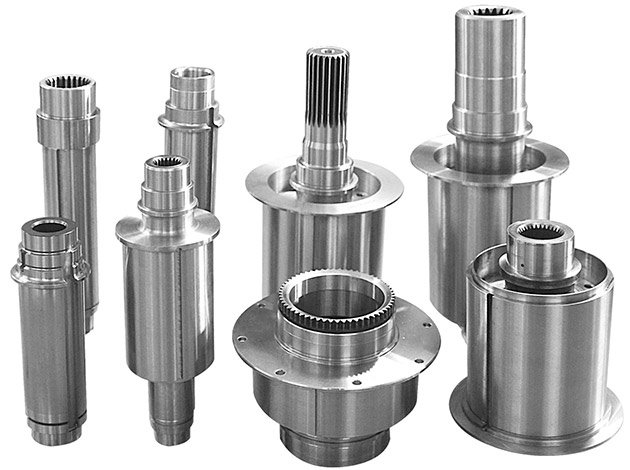
Hydraulic systems can use hard ceramic inserts in metering elements, valve seats, nozzles, and pump wear interfaces. These components must maintain controlled clearances under pressure and resist erosion from continuous fluid movement. When combined with precision-machined metal bodies, sapphire or ruby inserts can improve service life and maintain predictable system behavior. Dixin Technology’s hydraulic pump parts manufacturing experience supports the development of related housings, shafts, sleeves, and precision wear components.
Analytical and Laboratory Instruments
Laboratory dosing systems, chromatography equipment, flow meters, and chemical analyzers require stable flow paths and minimal contamination. Ruby and sapphire orifices can provide a durable interface for repeated dispensing cycles, while sapphire windows can support optical monitoring of fluid conditions. Dimensional consistency is essential because dosing accuracy often depends on a calibrated orifice or a precisely controlled valve stroke.
Medical and Pharmaceutical Systems
Medical pumps, infusion equipment, diagnostic instruments, and pharmaceutical processing systems may benefit from materials that resist corrosion and repeated sterilization conditions. The design must account for biocompatibility, cleaning method, particle control, and regulatory documentation. Depending on the application, ruby or sapphire parts may be used in small pump interfaces, wear points, metering components, or optical fluid-path elements. A controlled inspection and documentation process is necessary when the component is part of a regulated device.
Semiconductor and Chemical Processing
Semiconductor manufacturing and chemical processing equipment expose components to aggressive chemicals, high-purity fluids, and demanding cleanliness requirements. Sapphire can be used for chemically resistant windows, guides, insulators, or precision flow interfaces. Here, packaging and contamination control are as important as dimensional accuracy. The supplier must understand clean handling requirements and ensure that machining residues, polishing compounds, and foreign particles are removed and controlled.
Aerospace and Energy Systems
Aerospace fuel, lubrication, and environmental-control systems may include precision flow-control components operating under vibration, pressure variation, and temperature extremes. Energy equipment can similarly require durable metering and sealing elements for fuel, gas, or process-fluid systems. While ruby and sapphire parts are usually small, their failure can affect system availability and maintenance intervals. Qualification should therefore include environmental testing and a clear replacement strategy.
Across all these industries, the right sourcing model begins with application data: fluid chemistry, temperature range, pressure, flow rate, cycle frequency, mating materials, cleanliness level, and required service life. Those inputs determine whether ruby, sapphire, another industrial ceramic, or a hybrid design offers the best balance of performance and cost.
5. Call to Action
Ruby and sapphire component machining requires more than a high-hardness material and a precision machine. It requires coordinated engineering, controlled abrasive processing, stable fixturing, disciplined inspection, and a supply chain structured for repeatability. Dixin Technology provides this ODM and manufacturing support for global OEMs and Tier 1 suppliers developing fluid control systems, pumps, valves, instruments, and industrial equipment.
Share your drawing, sample, performance specification, or annual demand forecast with the IndustryApex CNC team. Dixin Technology can help review material selection, tolerances, machining routes, inspection requirements, packaging, and production planning. To discuss a new component or improve an existing supply program, contact us for an engineering and sourcing consultation. Explore the company’s broader precision manufacturing capabilities at the IndustryApex CNC home page.