- Shaft
- Molds&Tools
- Hydraulics And Pump
- Hair transplant needle
- Hydraulics And Pump
- Precision CNC Shaft Machining Manufacturer for High Performance Applications
- Energy Industry CNC Machining Parts Supplier
- Aerospace CNC Machining Parts Manufacturer
- Aerospace CNC Machining Parts Manufacturer
- Automotive & EV CNC Machining Parts Supplier for OEM and Tier 1
- Medical CNC Machining Parts Supplier for Precision Medical Devices

The Future of Robotics Components in 2026: Micron-Level Precision, ODM Integration, and Supply Chain Resilience

Published by Dixin Technology | IndustryApex CNC
The Future of Robotics Components in 2026: Micron-Level Precision, ODM Integration, and Supply Chain Resilience
As robotics moves from controlled factory cells into warehouses, operating rooms, aircraft production lines, laboratories, and intelligent infrastructure, the performance requirements for every component are becoming more demanding. In 2026, micron-level precision will no longer be limited to a small group of high-end automation applications. It will increasingly define the standard for robotic joints, actuator housings, gear components, end-effectors, sensor mounts, fluid-control elements, and structural interfaces.
1. Executive Summary
The future of robotics manufacturing will be shaped by three connected priorities: dimensional precision, system-level integration, and supply chain reliability. Robotic systems require components that maintain repeatable geometry under continuous motion, vibration, thermal cycling, variable loads, and demanding duty cycles. A small deviation in a bearing seat, shaft diameter, gear profile, or end-effector interface can create backlash, positioning errors, excessive wear, and costly downtime across an entire production system.
Micron-level manufacturing is therefore becoming a strategic capability rather than a narrow quality target. It combines high-performance CNC machining with process control, advanced metrology, material expertise, digital production management, and engineering collaboration. For global OEMs and Tier 1 suppliers, the ideal partner must do more than produce individual parts. It must coordinate design for manufacturability, prototype development, production planning, quality assurance, inventory strategy, and global delivery.
Dixin Technology, operating through IndustryApex CNC, addresses this requirement as a supply chain integrator and ODM solution provider. With more than 30 years of manufacturing experience, a fully controlled precision manufacturing system supported by ERP, and capabilities spanning 3- to 5-axis CNC machining, EDM, precision grinding, and industrial ceramics, the company helps robotics manufacturers convert complex designs into stable, scalable production programs.
For buyers evaluating future-ready suppliers, the central question is not simply whether a factory can achieve a micron-level tolerance once. The more important question is whether it can achieve that tolerance consistently across materials, batches, machines, operators, inspection stages, and delivery cycles.
2. Technical Deep Dive
Why micron-level precision matters in robotics
Robots are integrated motion systems. Their accuracy depends on the combined performance of numerous components rather than on a single part. A robotic arm may contain precision shafts, harmonic-drive interfaces, planetary gear elements, bearing seats, motor couplings, cable-routing features, and lightweight structural components. If each interface introduces even a small amount of error, the accumulated effect can reduce repeatability and create calibration drift.
Micron-level precision is particularly important in mating surfaces and functional datums. Bearing bores must maintain correct circularity and coaxiality. Gear components require controlled tooth geometry, surface finish, and runout. Actuator housings must preserve alignment between motor, reducer, and output shaft locations. End-effector mounting faces need stable flatness and positional accuracy so that tooling can be exchanged without repeated manual adjustment.
Precision also supports reliability. When clearances are too large, vibration and backlash increase. When clearances are too tight, thermal expansion or contamination can cause binding. The objective is not simply to make every dimension as small as possible; it is to establish a controlled relationship between tolerances, materials, operating temperature, lubrication, load, and expected service life.
Material and process selection
Robotics components are manufactured from a wide range of materials, including aluminum alloys, stainless steels, alloy steels, titanium, engineering plastics, hardened tool steels, and technical ceramics. Each material creates different machining and inspection challenges. Aluminum supports lightweight robot architecture but may require careful control of deformation and burr formation. Hardened steels provide wear resistance but often demand grinding, EDM, or specialized tooling. Titanium offers an excellent strength-to-weight ratio, yet its low thermal conductivity and high chemical reactivity can complicate cutting operations.
Industrial ceramics are increasingly relevant for robotic systems exposed to high temperatures, electrical insulation requirements, abrasive environments, or aggressive chemicals. Ceramic components can deliver exceptional hardness, dimensional stability, and wear resistance, but their production requires disciplined control of sintering, grinding, edge preparation, and inspection. A supplier with both metal and ceramic expertise can help OEMs select the most suitable material for each functional requirement instead of forcing every application into a conventional metal solution.
From CNC machining to precision grinding and EDM
Modern robotic component production frequently requires a combination of manufacturing technologies. 3-axis CNC machining is effective for many prismatic and rotational parts, while 4- and 5-axis machining can reduce setups, improve datum control, and access complex geometries. Fewer setups can reduce cumulative alignment error and shorten production time for integrated actuator bodies, lightweight brackets, and contoured structural components.
EDM is valuable for hardened materials, narrow slots, intricate profiles, and geometries that are difficult to produce economically with conventional cutting. Precision grinding supports final control of cylindrical dimensions, flatness, surface finish, and form accuracy. The most effective process route is determined by the component’s function, material, tolerance, production volume, and inspection requirements.
Manufacturing precision must be supported by measurement precision. Coordinate measuring machines, optical inspection, surface-finish measurement, roundness testing, gauge calibration, and in-process verification provide evidence that a component conforms to its drawing and functional requirements. In 2026, customers will increasingly expect digital inspection records, traceability by lot, and clear documentation of critical characteristics.
Design for precision and manufacturability
Micron-level outcomes are influenced long before a part reaches the machine tool. Designers can improve manufacturability by identifying functional datums, separating cosmetic from critical surfaces, defining realistic geometric tolerances, avoiding unnecessary thin walls, and specifying surface finishes according to actual contact or sealing requirements. Proper tolerance allocation is especially important in assemblies containing bearings, gears, reducers, encoders, and precision fasteners.
Early supplier involvement can reveal where a design is over-constrained, where a tolerance can be relaxed without affecting performance, and where a small geometry change can eliminate a costly secondary operation. This approach reduces development risk and supports a smoother transition from prototype quantities to repeat production.
3. The ODM & Supply Chain Advantage
Robotics OEMs and Tier 1 suppliers are under pressure to shorten development cycles while increasing localization, traceability, and production flexibility. Outsourcing individual machining operations is not always enough to meet these objectives. Buyers increasingly need a partner that can connect engineering decisions with production execution and supply chain management.
Dixin Technology’s core identity is that of a supply chain integrator and ODM solution provider. This means the company can support customers across the product lifecycle, from design review and material selection to process development, quality validation, batch production, and delivery coordination. The objective is to create a dependable manufacturing system around the customer’s product rather than treat each purchase order as an isolated transaction.
A fully controlled precision manufacturing system
With more than 30 years of experience, Dixin Technology has developed a manufacturing structure designed to control quality, capacity, and delivery performance. ERP-supported production management helps connect engineering data, purchasing, scheduling, work orders, inventory, inspection results, and shipment planning. This visibility is essential when robotics customers manage multiple programs with different revision levels, qualification requirements, and demand forecasts.
A controlled system also improves responsiveness. When a customer changes a drawing, increases volume, or introduces a new material, the supplier can evaluate the effect across procurement, tooling, machine loading, inspection, and delivery. This reduces the communication gaps that often occur when design, machining, finishing, and logistics are spread across unrelated subcontractors.
Integrated manufacturing capabilities
Dixin Technology combines 3- to 5-axis CNC machining, EDM, precision grinding, and industrial ceramics within its broader capability platform. This range supports the production of complex robotic components that require multiple processes or specialized material expertise. It also enables a more coordinated approach to tolerance management, because process decisions can be evaluated against the complete component and assembly requirement.
For example, a robotic actuator housing may require multi-axis machining for complex external geometry, precision boring for bearing locations, grinding for a critical shaft or sleeve, and specialized finishing for wear or corrosion resistance. A precision end-effector may combine lightweight machined structures with hardened locating elements or ceramic insulation components. Managing these requirements through an integrated partner can reduce handoff risk, simplify quality documentation, and improve schedule control.
Supply chain resilience in 2026
Future supply chain performance will depend on more than low unit cost. Robotics manufacturers must consider material availability, alternative process routes, capacity redundancy, tooling ownership, inspection capability, export compliance, packaging, and the supplier’s ability to support engineering changes. A partner with broad process capabilities can offer practical alternatives when a material, machine, or finishing route becomes constrained.
ODM collaboration also helps customers standardize families of components. Similar shafts, housings, plates, brackets, and fluid-control parts can be designed around common datums, tooling concepts, and inspection methods. This can reduce the number of unique parts in a robotic platform, simplify sourcing, and improve economies of scale without compromising application-specific performance.
Experience in other high-reliability markets further strengthens this approach. Dixin Technology supports demanding manufacturing requirements for aerospace structural and titanium components, as well as medical components and high-precision device parts. These sectors reinforce disciplines in traceability, process validation, documentation, and dimensional control that are also valuable for robotics programs.
4. Industry Applications
Collaborative and industrial robots
Collaborative robots require lightweight structures, smooth motion, compact actuators, and reliable safety-related performance. Precision-machined arm links, joint housings, bearing interfaces, tool changers, and sensor mounts must support repeatable operation while minimizing mass. Industrial robots used for welding, assembly, palletizing, and material handling place additional emphasis on stiffness, fatigue resistance, thermal management, and long-term wear performance.
Warehouse automation and mobile robotics
Autonomous mobile robots and warehouse systems operate in environments where shock, vibration, dust, and frequent start-stop cycles are common. Drive shafts, wheel hubs, gearbox components, encoder mounts, and chassis interfaces must maintain alignment despite continuous movement. Tight control of concentricity and surface finish can improve bearing life and reduce maintenance events.
Medical and laboratory robotics
Medical and laboratory robots demand precision, cleanability, corrosion resistance, and dependable repeatability. Components may include instrument interfaces, miniature mechanisms, fluid-handling elements, surgical tool parts, and diagnostic equipment structures. The production system must support material traceability and consistent finishing while meeting demanding dimensional and documentation requirements.
Aerospace and defense robotics
Aerospace robotics, unmanned systems, and automated aircraft production equipment place strong emphasis on weight reduction, structural integrity, environmental resistance, and configuration control. Titanium, aluminum, high-strength steels, and advanced ceramics may all be required within a single platform. Five-axis machining and careful process planning can support complex lightweight structures while maintaining critical alignment relationships.
Fluid handling and process automation
Robotic systems used in chemical processing, food production, packaging, and energy applications often depend on precision valves, pump parts, manifolds, impellers, and sealing interfaces. Dixin Technology’s experience with hydraulic pump parts is relevant to robotic equipment that incorporates hydraulic or pneumatic actuation. Controlled spool, sleeve, bore, and sealing geometries can improve flow regulation and reduce leakage.
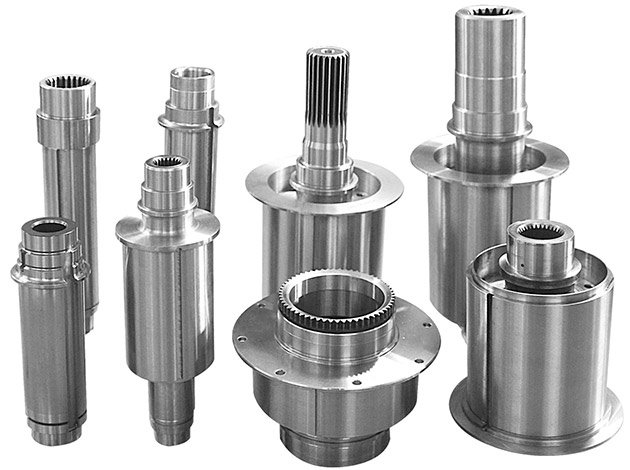
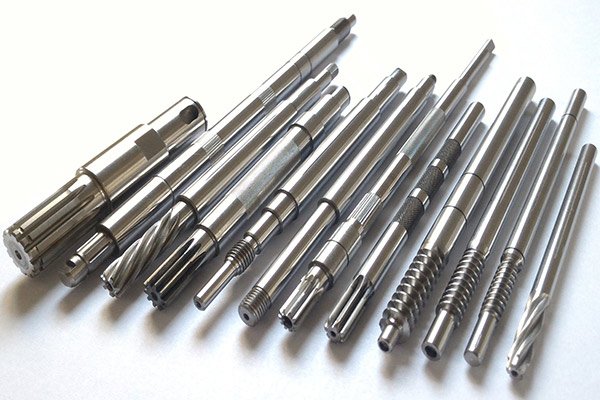
Precision gears, shafts, and transmission components
Transmission elements remain central to robotic performance. Shafts, splines, sleeves, gears, eccentric components, and reducer interfaces must balance dimensional accuracy with fatigue strength and surface durability. Even when a supplier does not manufacture the complete gearbox, its ability to produce compatible shafts, housings, and precision interfaces can help the OEM maintain a stable assembly process.
Across all these applications, the most successful sourcing strategy is application-specific. A component should be evaluated according to load, speed, environmental exposure, required life, maintenance model, and total system cost. Micron-level precision is most valuable when it is connected to a measurable performance objective such as improved repeatability, lower vibration, longer bearing life, reduced leakage, or faster calibration.
5. Call to Action
In 2026, robotics manufacturers will compete not only through software and artificial intelligence, but also through the physical precision and supply chain discipline built into every machine. Components that appear small or simple can determine the accuracy, reliability, and service life of an entire robotic platform.
Global OEMs and Tier 1 suppliers should engage their manufacturing partner early, especially when developing new actuator architectures, lightweight structures, precision transmission components, fluid-control assemblies, or ceramic interfaces. Early collaboration allows tolerance reviews, process selection, material evaluation, inspection planning, and cost optimization to happen before production constraints become expensive engineering changes.
Explore the IndustryApex CNC precision manufacturing platform to review Dixin Technology’s capabilities for complex industrial components. For application-specific support, capacity planning, or an ODM manufacturing consultation, contact the Dixin Technology team with your drawings, 3D models, target quantities, materials, and critical performance requirements.
With integrated engineering, precision manufacturing, ERP-enabled supply chain control, and more than three decades of experience, Dixin Technology is positioned to help robotics companies turn micron-level requirements into repeatable production results.