- Shaft
- Molds&Tools
- Hydraulics And Pump
- Hair transplant needle
- Hydraulics And Pump
- Precision CNC Shaft Machining Manufacturer for High Performance Applications
- Energy Industry CNC Machining Parts Supplier
- Aerospace CNC Machining Parts Manufacturer
- Aerospace CNC Machining Parts Manufacturer
- Automotive & EV CNC Machining Parts Supplier for OEM and Tier 1
- Medical CNC Machining Parts Supplier for Precision Medical Devices

Why Choose China for High-Precision CNC Shaft Machining? A Global OEM and Supply Chain Analysis


Why Choose China for High-Precision CNC Shaft Machining?
For global OEMs and Tier 1 suppliers, selecting a CNC shaft machining partner involves more than comparing unit prices. Shaft performance depends on dimensional stability, concentricity, surface integrity, material traceability, heat treatment, inspection discipline, and reliable delivery. China has become a major sourcing base for high-precision CNC shaft machining because it combines deep manufacturing capacity, broad process capability, integrated supply chains, and competitive total cost.
Dixin Technology, operating through the IndustryApex CNC platform, supports international customers with precision machined shafts and engineered components for demanding industrial applications. Its role extends beyond contract machining: the company functions as a supply chain integrator and ODM solution provider for customers requiring controlled development, production, inspection, and delivery.
1. Executive Summary
China is a practical sourcing destination for high-precision CNC shafts when the supplier is selected according to engineering capability and supply chain maturity rather than price alone. The country offers access to advanced turning centers, mill-turn equipment, 3-axis to 5-axis CNC machining, wire and sinker EDM, precision grinding, industrial ceramics, heat treatment networks, coating suppliers, and specialized inspection laboratories.
The main commercial advantage is manufacturing density. Raw materials, secondary processes, tooling, finishing, packaging, and logistics can often be coordinated within one regional supply chain. This reduces handoffs, shortens development cycles, and gives OEM buyers greater flexibility when volumes change. A capable Chinese supplier can also support design for manufacturability, prototype validation, process documentation, and transition into stable serial production.
For buyers evaluating China, the key questions should include:
- Can the supplier maintain shaft concentricity, runout, diameter, and surface-finish requirements over repeated production batches?
- Are material certificates, heat-treatment records, coating reports, and inspection data traceable to each lot?
- Does the manufacturer control critical processes internally or rely on unmanaged subcontracting?
- Can engineering, quality, purchasing, and logistics teams communicate effectively with the customer?
- Does the supplier have the capacity and systems required for both prototypes and production quantities?
When these controls are in place, China can provide a strong balance of precision, scalability, engineering support, and total landed cost.
2. Technical Deep Dive
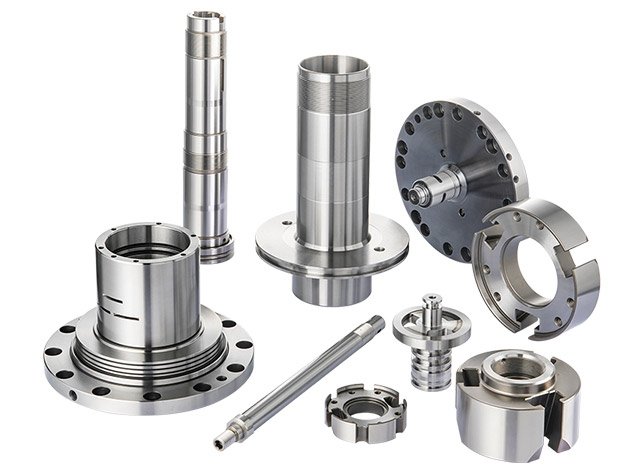
A precision shaft is a functional datum system, not simply a round bar turned to size. Its journals, shoulders, threads, keyways, splines, grooves, tapers, and end features must work together under rotational load. Small errors in coaxiality or runout can produce vibration, uneven bearing wear, seal failure, noise, heat generation, and premature fatigue.
Process capability for demanding shaft geometries
Modern CNC turning centers are well suited to cylindrical shafts, stepped shafts, threaded shafts, pins, axles, spindles, and actuator components. Live tooling and mill-turn platforms can add cross-holes, flats, slots, and off-axis features without repeatedly resetting the workpiece. This reduces datum transfer errors and improves positional consistency.
For components with complex intersecting surfaces or multiple angular features, 3-axis, 4-axis, and 5-axis machining can provide more efficient access and fewer fixtures. This is important for aerospace structural components and rotating assemblies where the relationship between machined features affects installation and operational performance. Dixin Technology also supports customers looking for specialized aerospace CNC machining and titanium aircraft parts.
Precision grinding is often used after turning or heat treatment when a shaft requires tighter journal tolerances, improved roundness, or a controlled surface finish. Grinding can be essential for bearing seats, hydraulic spools, motor shafts, and other components where friction, leakage, or assembly force depends on surface geometry. EDM is valuable for narrow slots, difficult conductive materials, and geometries that are challenging to produce economically with conventional cutting tools.
Material and surface engineering
Chinese machining suppliers commonly work with carbon steels, alloy steels, stainless steels, aluminum alloys, brass, copper, titanium, nickel-based alloys, engineering plastics, and technical ceramics. Material selection should be connected to the operating environment. A high-speed motor shaft may require fatigue strength and balanced mass. A hydraulic spool may require tight clearance control and wear resistance. A medical shaft or instrument component may require corrosion resistance, biocompatibility considerations, and validated cleaning or passivation processes.
Secondary operations can include carburizing, nitriding, induction hardening, vacuum heat treatment, anodizing, electroless nickel plating, chrome plating, black oxide, passivation, and physical vapor deposition coatings. The purchasing specification should identify the required hardness range, case depth, coating thickness, dimensional allowance, and post-treatment inspection method. Without these details, a nominally compliant part can still fail in service because the surface treatment changes dimensions or alters fatigue behavior.
Inspection and quality assurance
Reliable shaft production requires inspection at several stages. Incoming material verification confirms grade and lot identity. In-process checks monitor critical diameters, lengths, and tool wear. Final inspection may use coordinate measuring machines, roundness testers, cylindricity measurement, optical comparators, thread gauges, surface roughness testers, hardness testers, and runout fixtures.
For OEM supply, inspection records should be linked to drawing revision, production lot, material batch, and defined acceptance criteria. Statistical process control can identify drift before parts reach the customer. First article inspection, capability studies, control plans, and corrective action reports provide additional confidence when a component is safety-critical or incorporated into a regulated product.
The result is a more controlled production path from raw material to finished shaft. This is one reason experienced buyers assess the supplier’s process ownership and documentation system as carefully as its machine list.
3. The ODM & Supply Chain Advantage
The strongest reason to consider China for CNC shaft machining is not labor cost in isolation. It is the combination of manufacturing depth and supply chain integration. Dixin Technology’s core identity is a supply chain integrator and ODM solution provider. This means the supplier can participate earlier in the product lifecycle, helping convert a design concept or customer drawing into a manufacturable, documented, and scalable component.
Engineering support from design to production
An effective ODM partner reviews tolerances, datum structures, tool access, stock allowances, corner radii, thread standards, heat-treatment distortion, inspection requirements, and packaging conditions before production begins. For shaft components, design review may reveal that a bearing seat tolerance is tighter than necessary, a deep groove needs a different tool approach, or a heat-treatment allowance should be added to protect the final grinding operation.
These changes should be controlled through documented engineering approval. The objective is not to alter the customer’s functional intent, but to protect performance while improving repeatability, yield, lead time, and cost.
Controlled manufacturing infrastructure
Dixin Technology operates a fully controlled precision manufacturing system supported by ERP and more than 30 years of experience. ERP-based production control improves visibility across purchasing, work orders, capacity planning, inventory, quality status, and shipment scheduling. For global customers, this makes it easier to track order progress and manage forecasts without relying on informal communication.
The manufacturing edge includes 3-axis to 5-axis CNC machining, EDM, precision grinding, and industrial ceramics. This range allows the company to coordinate multiple technologies for assemblies and related component families. It can also reduce the number of external handoffs, which helps limit delays, packaging damage, inconsistent inspection methods, and unclear responsibility for nonconforming parts.
Total cost and supply continuity
Unit price remains relevant, but total cost includes engineering time, tooling, inspection, freight, inventory, rework, customs coordination, and line-down exposure. A supplier that provides accurate quotations, stable processes, consolidated shipments, and preventive quality controls can offer a lower total cost even when its piece price is not the lowest available.
China’s industrial ecosystem also supports flexible sourcing strategies. OEMs can begin with prototypes, progress to pilot batches, and then scale into recurring production while retaining one technical partner. This continuity reduces the risk of redesigning processes during commercialization. It is particularly useful for customers whose demand varies across regions or whose products have multiple shaft variants.
For global OEM and Tier 1 suppliers, supplier communication and documentation are also strategic assets. Clear English-language drawings, inspection reports, deviation requests, packing lists, and shipment records help integrate the Chinese supplier into an established procurement and quality system.
4. Industry Applications
High-precision CNC shafts are used wherever controlled rotation, guided motion, fluid metering, or accurate alignment is important. The application determines the appropriate material, process sequence, tolerance strategy, and validation plan.
Aerospace and defense
Aerospace shafts and rotating components may require titanium, stainless steel, nickel alloys, or high-strength steels, along with strict traceability and specialized inspection. Weight, fatigue performance, corrosion resistance, and interface accuracy are central considerations. Multi-axis machining and coordinated grinding can support complex structural and actuation components.
Medical and laboratory equipment
Medical device shafts, surgical instrument components, dental mechanisms, and high-precision device parts often demand corrosion-resistant materials, burr-free edges, fine surface finishes, and carefully controlled cleaning. Dixin Technology supports projects involving ISO-certified CNC machining for medical components, including titanium implants, surgical instruments, and precision device parts.
Hydraulics and fluid control
Hydraulic valve spools, sleeves, pump shafts, and actuator rods depend on precise diameters, roundness, surface roughness, and clearance relationships. Even a small surface defect can cause leakage, sticking, or accelerated wear. Customers sourcing hydraulic pump parts should specify pressure conditions, fluid compatibility, hardness, coating requirements, and the method used to verify critical fits.
Automotive, robotics, and industrial automation
Motor shafts, transmission shafts, splined shafts, eccentric shafts, robotic joints, guide shafts, and actuator components must withstand repeated cycles and varying loads. Production efficiency, balancing, concentricity, and reliable repeatability are often more important than prototype speed alone. A supplier with integrated turning, milling, grinding, and inspection can support both development and high-volume programs.
Energy, pumps, and process equipment
Energy equipment and industrial pumps expose shafts to vibration, temperature, corrosion, and continuous duty. Material certification, heat treatment, dynamic balance, coating performance, and dimensional stability should be addressed during design review. China offers broad access to process suppliers capable of supporting these requirements, provided the manufacturer actively manages the complete process chain.

5. Call to Action
Choosing China for high-precision CNC shaft machining is a supply chain decision as much as a machining decision. The right partner combines technical process control, transparent documentation, responsive engineering, and dependable production planning. Dixin Technology brings more than 30 years of manufacturing experience, ERP-supported operations, broad precision capabilities, and an ODM approach designed for global OEM and Tier 1 supplier requirements.
To evaluate a new shaft project, prepare the latest drawings, 3D models, material and heat-treatment requirements, annual volume, forecast profile, inspection standards, and target delivery schedule. Dixin Technology can review the design, recommend a process route, identify manufacturing risks, and prepare a quotation for prototype or serial production.
Explore the IndustryApex CNC precision manufacturing platform or contact Dixin Technology to discuss high-precision CNC shaft machining, integrated component sourcing, and long-term supply support.