- Shaft
- Molds&Tools
- Hydraulics And Pump
- Hair transplant needle
- Hydraulics And Pump
- Precision CNC Shaft Machining Manufacturer for High Performance Applications
- Energy Industry CNC Machining Parts Supplier
- Aerospace CNC Machining Parts Manufacturer
- Aerospace CNC Machining Parts Manufacturer
- Automotive & EV CNC Machining Parts Supplier for OEM and Tier 1
- Medical CNC Machining Parts Supplier for Precision Medical Devices
Large-Scale Machining: Gantry Milling and Crankshaft Grinding for Global OEM Supply Chains

Large-Scale Machining: Gantry Milling and Crankshaft Grinding for Global OEM Supply Chains
Executive Summary
Large-scale machining determines the performance, reliability, and delivery confidence of many capital-intensive industrial systems. From heavy machine frames and energy equipment to high-load engines, pumps, and motion systems, large components must retain dimensional stability while meeting demanding surface-finish, alignment, and fatigue-life requirements. Two processes are especially important in this environment: gantry milling for large structural and prismatic components, and crankshaft grinding for rotating shafts with complex journal geometry.
For global OEMs and Tier 1 suppliers, selecting a machining partner is not simply a matter of machine-envelope size. The supplier must control fixturing, material traceability, in-process inspection, process sequencing, finishing, packaging, and export-ready documentation. A capable partner also needs the engineering discipline to anticipate distortion, thermal movement, grinding burn, runout, and tolerance stack-up before they become production failures.
Dixin Technology, operating through IndustryApex CNC, supports customers that require a coordinated approach to precision machining and supply-chain execution. By integrating engineering review, controlled production, precision finishing, and quality management, the company helps OEM sourcing teams reduce supplier interfaces without sacrificing technical depth. This article explains how gantry milling and crankshaft grinding work, where their risks lie, and why an ODM-oriented manufacturing partner creates measurable value for complex programs.
Technical Deep Dive
Gantry milling is designed for workpieces whose size, mass, or geometry makes conventional vertical machining impractical. The machine architecture uses a bridge-like gantry spanning a large table, allowing the spindle to travel across wide and long work envelopes while maintaining the rigidity needed for heavy cutting. Typical applications include welded machine bases, casting molds, structural frames, large housings, turbine-related components, industrial automation beds, and construction-equipment structures.
The key engineering challenge in gantry milling is maintaining geometric accuracy over distance. A feature can be correct at one end of a large part yet drift outside tolerance at the other if machine calibration, fixture strategy, thermal compensation, or datum planning is weak. Engineers therefore begin with the part’s functional datums, mating interfaces, and critical load paths. Setup planning must establish stable references that survive multiple operations and allow inspection results to relate directly to the customer’s assembly requirements.
Material condition is equally important. Large castings and welded fabrications can contain residual stress, and aggressive stock removal may release that stress and cause the part to move. Dixin Technology evaluates stock allowance, heat-treatment status, machining sequence, and intermediate stabilization requirements before final finishing. Roughing, semi-finishing, rest periods where appropriate, and final finishing are sequenced to minimize distortion. Tool-path choices, cutter engagement, spindle load, and coolant delivery are also managed to preserve dimensional control and avoid excessive heat input.
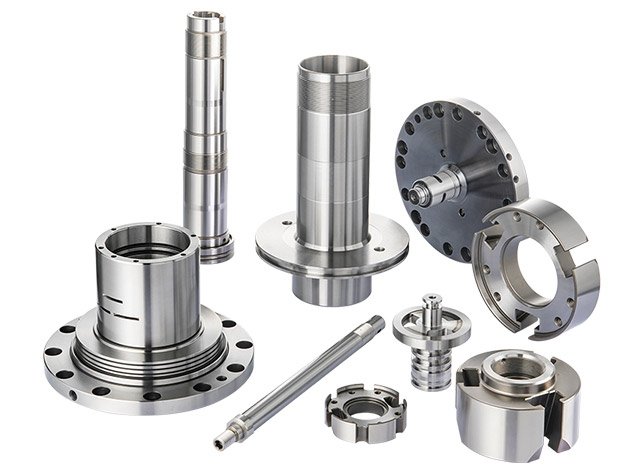
Precision crankshaft grinding addresses a different but equally demanding set of variables. A crankshaft is not a simple cylindrical shaft: its main journals and crankpin journals are offset, its fillets influence fatigue performance, and its balance and runout affect engine behavior. Grinding must generate accurate diameter, roundness, cylindricity, journal spacing, surface texture, and fillet geometry while preventing thermal damage to the hardened surface.
Crankshaft grinding commonly involves centering, indexing, journal grinding, fillet control, polishing, deburring, cleaning, and final inspection. Grinding-wheel specification must match the workpiece material, hardness, stock-removal requirement, and desired surface finish. Wheel dressing is not a secondary activity; it directly affects cutting behavior, heat generation, profile retention, and consistency from part to part. Coolant filtration and delivery must remove swarf while carrying heat away from the grinding zone. Inadequate cooling can create grinding burn, microstructural damage, tensile residual stress, or unacceptable surface integrity even when nominal dimensions appear correct.
Measurement must confirm more than journal diameter. Depending on the program, inspection may include concentricity, runout, stroke, angular position, journal taper, surface roughness, fillet radius, hardness, magnetic-particle inspection, and balance-related characteristics. Process capability is established through controlled sampling, documented inspection plans, and appropriate use of in-process gauging and final metrology. The objective is to deliver a shaft that performs reliably under cyclic load, not merely one that passes a single dimensional checkpoint.
Across both processes, manufacturability reviews are most effective when completed early. Engineers should identify overly restrictive tolerances, inaccessible surfaces, unsuitable datum schemes, incomplete material specifications, and inspection requirements that cannot be verified economically. Early dialogue lets the OEM protect functional requirements while removing unnecessary manufacturing risk, cost, and lead time.
The ODM & Supply Chain Advantage
Dixin Technology is positioned as a supply-chain integrator and ODM solution provider for global OEMs and Tier 1 suppliers. This role extends beyond producing individual machined parts. It means translating product requirements into a controlled manufacturing route, coordinating qualified processes, maintaining production visibility, and delivering components in a condition that supports efficient customer assembly and validation.
For large-scale machining programs, fragmented sourcing creates avoidable risk. One supplier may rough-machine a casting, another may heat-treat it, a third may grind critical surfaces, and a fourth may inspect or package the component. Every transfer increases the possibility of datum loss, handling damage, unclear accountability, incomplete traceability, and schedule disruption. A controlled manufacturing system reduces those handoffs and gives the customer a single technical point of responsibility.
Dixin Technology’s manufacturing edge is built on a fully controlled precision manufacturing system supported by ERP management and more than 30 years of industry experience. ERP-based production coordination improves material planning, work-order visibility, capacity scheduling, lot tracking, and delivery communication. For procurement teams, this supports clearer order status and fewer surprises. For engineering teams, it provides the discipline needed to connect approved drawings, revisions, routing instructions, inspection records, and shipping requirements.
The company’s technical capabilities include 3-axis to 5-axis CNC machining, EDM, precision grinding, and industrial ceramics. This breadth matters because large parts often require more than one machining method. A large milled housing may need deep features, tight bores, precision-ground interfaces, or EDM-produced details. A crankshaft program may require grinding alongside accurately machined flanges, keyways, oil passages, or associated components. Integrated capability enables process selection based on function rather than forcing designs into the limitations of a single shop technology.
ODM support also creates value when an OEM has a performance target but needs help finalizing the component for production. Dixin Technology can contribute design-for-manufacturing input on material choice, stock form, tolerance allocation, surface-finish callouts, fixture access, inspection strategy, and packaging protection. The goal is not to alter critical product intent; it is to make that intent repeatable at production scale. This is particularly valuable where a prototype drawing has not yet addressed large-part distortion, grinding access, transport constraints, or the economics of recurring production.
Quality assurance should be treated as a production function rather than a final gate. Effective control includes incoming material verification, first-article confirmation, in-process checks, final dimensional reporting, identification, traceability, and shipment protection. Where the application demands it, the quality plan can be expanded to include customer-specific documentation, material certifications, non-destructive testing coordination, and controlled preservation methods. The result is a supply model aligned with the expectations of international industrial customers.
Industry Applications
Large-scale gantry milling and crankshaft grinding support a broad range of industrial sectors. In drivetrain and engine production, crankshafts, eccentric shafts, transmission elements, and high-load rotating components require consistent geometry and surface integrity. These requirements are especially important when assemblies operate under high cyclic loads, elevated temperatures, or long service intervals.
Hydraulics, fluid-control, and pump equipment also rely on precision-machined and ground components. Large housings require stable sealing faces, accurately located bores, and reliable interfaces, while rotating shafts and sleeves must maintain controlled clearances and wear characteristics. Dixin Technology supports sourcing programs for hydraulic pump parts where machining quality directly influences volumetric efficiency, leakage control, and service life.
In aerospace manufacturing, structural components, fixtures, ground-support equipment, and specialized engine-related parts demand rigorous process planning and material control. Large structural machining must preserve datum integrity across complex geometries, while titanium and other demanding alloys require tooling and cutting strategies tailored to their behavior. Explore Dixin Technology’s capability for aerospace CNC machining and aircraft structural components for programs requiring advanced multi-axis precision.
Medical-device manufacturing demonstrates why controlled machining systems matter even when individual parts are smaller. Titanium implants, surgical instruments, and precision device components depend on robust traceability, exact finishing, and repeatable inspection. The same discipline used to manage critical large-part datums and grinding quality supports ISO-certified CNC machining for medical components.
Energy, construction machinery, automation, steel production, and industrial equipment manufacturers face similarly high expectations. Their parts often combine large envelopes, harsh operating environments, difficult materials, and high consequences of downtime. A supply partner must therefore balance precision with practical production planning, reliable lead times, and protected global delivery.
Call to Action
When your program requires large-scale gantry milling, crankshaft grinding, or a coordinated multi-process machining supply solution, engage Dixin Technology early in the sourcing cycle. Early technical review helps identify manufacturability issues, optimize routing, clarify quality documentation, and establish a supply plan that supports prototype, pilot, and production volumes.
Share your drawings, material requirements, annual volume expectations, inspection criteria, and delivery destination with the Dixin Technology engineering team. Contact IndustryApex CNC to discuss a precision manufacturing and ODM supply-chain solution for your next OEM or Tier 1 program.