- Shaft
- Molds&Tools
- Hydraulics And Pump
- Hair transplant needle
- Hydraulics And Pump
- Precision CNC Shaft Machining Manufacturer for High Performance Applications
- Energy Industry CNC Machining Parts Supplier
- Aerospace CNC Machining Parts Manufacturer
- Aerospace CNC Machining Parts Manufacturer
- Automotive & EV CNC Machining Parts Supplier for OEM and Tier 1
- Medical CNC Machining Parts Supplier for Precision Medical Devices

Precision CNC Machining for EV Motor Housings: Tight Tolerances, Thermal Control, and Supply Chain Reliability

Precision CNC Machining for EV Motor Housings: Tight Tolerances Explained
Electric vehicle motor housings are structural, thermal, and functional components that directly influence motor efficiency, NVH performance, bearing life, and system reliability. As EV platforms become more compact and powerful, manufacturers require aluminum and other lightweight alloy housings with highly controlled geometry, stable datums, accurate bearing bores, and reliable sealing surfaces. Precision CNC machining provides the process control needed to achieve these requirements at prototype, pilot, and production volumes.
1. Executive Summary
An EV motor housing is more than a protective enclosure. It establishes the position of the stator, rotor, bearings, resolver, cooling passages, gearbox interfaces, and mounting points. Small errors in concentricity, flatness, perpendicularity, or bore size can create air-gap variation, vibration, heat concentration, lubricant leakage, or premature bearing failure.
For this reason, tight tolerances must be assigned according to functional relationships rather than applied uniformly across every surface. A precision CNC machining partner evaluates the complete tolerance stack, selects appropriate datums, controls material distortion, and verifies critical features using calibrated inspection equipment. The result is a housing that supports repeatable assembly and dependable operation across the vehicle’s service life.
Dixin Technology, operating through IndustryApex CNC, supports global OEMs and Tier 1 suppliers with integrated engineering, machining, inspection, and supply chain coordination. Its capabilities include 3- to 5-axis CNC machining, EDM, precision grinding, industrial ceramics, and ERP-controlled production management. This combination helps customers move from design intent to manufacturable, traceable, and scalable EV motor housing production.
2. Technical Deep Dive
EV motor housings are commonly produced from aluminum alloys because they combine low density, useful thermal conductivity, corrosion resistance, and good machinability. Castings, extrusions, and forged blanks may all be used, depending on the housing architecture and production quantity. CNC machining then creates the functional interfaces that casting or forging alone cannot hold consistently.
The most important feature is usually the bearing bore system. Bearing seats must maintain the specified diameter, roundness, cylindricity, and surface finish while remaining concentric with the stator pocket and rotor axis. A housing can meet an individual bore diameter tolerance and still fail if the two bores are misaligned. Therefore, inspection must evaluate the relationship between datums, not only isolated dimensions.
Typical critical controls may include bearing bore diameter tolerances in the hundredths-of-a-millimeter range, tight coaxiality or total runout requirements, controlled stator pocket geometry, and precise mounting-face flatness. The exact values depend on motor size, bearing design, rotor speed, thermal load, and customer specifications. A capable supplier should recommend tolerances based on function and process capability instead of promising unnecessarily restrictive tolerances that increase cost without improving performance.
Datum strategy is fundamental. A primary datum may be the main mounting face, while secondary and tertiary datums establish the motor axis and clocking orientation. Machining sequences should reference stable surfaces and preserve the relationship between bearing seats, stator registers, cooling channels, and gearbox interfaces. When a part must be re-fixtured, the manufacturing plan should use locating features that minimize accumulated error.
Thermal effects also require careful management. Aluminum expands significantly during machining and inspection, so temperature stabilization is essential when verifying precision bores and positional relationships. Cutting heat, tool wear, coolant temperature, and fixture contact can all influence results. Dixin Technology’s controlled manufacturing system can combine process planning, ERP tracking, in-process checks, and final inspection to reduce variation across batches.
Thin walls and asymmetric ribs create another challenge. Removing material from a cast or forged blank can release residual stress, causing walls to move after roughing. A robust process commonly separates rough machining, stress-relief or stabilization when appropriate, semi-finishing, and final finishing. Balanced material removal, adaptive toolpaths, sharp tools, suitable cutting parameters, and rigid fixturing help protect wall thickness and dimensional stability.
Surface finish matters at several interfaces. Bearing seats require a finish suitable for the bearing fit and load condition. Sealing faces need controlled roughness and flatness to prevent coolant or lubricant leakage. Stator registers should avoid burrs and impact damage that could distort the electromagnetic assembly. Threaded holes, dowel bores, and fastening surfaces also require attention because assembly forces can magnify small positional errors.
Inspection planning should be developed alongside the manufacturing process. Coordinate measuring machines can verify bore locations, true position, perpendicularity, flatness, and profile. Air gauges or specialized bore gauges may provide fast production checks for critical diameters. Surface roughness instruments, height gauges, optical systems, and thread gauges can supplement CMM data. For high-volume programs, the supplier should define sampling plans, measurement-system analysis, capability studies, and reaction procedures for out-of-control trends.
Traceability is equally important. Each batch should be linked to material certificates, machining programs, tool or process revisions, inspection records, and nonconformance decisions. This is particularly valuable when the motor housing is part of a safety-relevant traction system or when multiple plants share the same design. A documented corrective-action process can identify whether variation originated in material, fixturing, tooling, programming, inspection, or assembly.
Design for manufacturability can reduce cost while improving precision. Engineers should avoid unnecessarily deep narrow cavities, provide adequate tool access, specify realistic corner radii, separate cosmetic requirements from functional requirements, and identify critical-to-function features clearly. Machining allowances should account for casting variability and expected distortion. Where possible, common tooling, standardized datums, and modular fixtures support faster changeover and better repeatability.
3. The ODM & Supply Chain Advantage
For EV programs, the machining supplier’s value extends beyond cutting metal. A housing may involve casting or forging procurement, material certification, CNC machining, deburring, washing, leak testing, dimensional inspection, surface treatment, packaging, and delivery to an assembly plant. Managing these activities through disconnected vendors increases handoffs, communication gaps, and schedule risk.
Dixin Technology’s core identity is that of a supply chain integrator and ODM solution provider. This means the team can participate early in product definition, review drawings and 3D models, assess manufacturability, propose process improvements, and coordinate production resources through an integrated operating model. For global OEM and Tier 1 suppliers, this approach can simplify supplier management while improving accountability for quality, cost, and delivery.
The company’s manufacturing edge is built on a fully controlled precision manufacturing system supported by ERP and more than 30 years of experience. ERP-based control can connect quotations, engineering revisions, work orders, material status, inspection results, inventory, and shipment planning. Such visibility is particularly valuable for EV launches, where engineering changes and forecast adjustments may occur frequently.
Technology capability is another differentiator. Three- to 5-axis CNC machining supports complex housing geometries, angled cooling features, multi-face access, and reduced setup count. EDM can address specialized features or difficult conductive materials when conventional cutting is unsuitable. Precision grinding supports demanding surface and dimensional requirements, while industrial ceramics extend the company’s ability to supply wear-resistant, electrically insulating, or thermally stable components used across advanced manufacturing systems.
A mature ODM process typically begins with a design review and tolerance-stack analysis. The supplier then develops a process route, fixture concept, tool plan, inspection strategy, and preliminary cost model. During sampling, first-article data validates assumptions and identifies opportunities to adjust tolerances, datums, or machining order. Once approved, process documentation and ERP controls support repeatable production and controlled engineering changes.
Supply chain resilience also depends on capacity planning. EV customers should ask how a supplier manages peak demand, machine redundancy, critical tooling, raw material availability, subcontracted processes, and contingency planning. A partner with in-house control over core operations can respond more quickly to disruptions than a fragmented network, while still using qualified external resources when specialized finishing or testing is required.
Quality assurance should be measurable. Useful indicators include first-pass yield, on-time delivery, process capability for critical characteristics, nonconformance recurrence, corrective-action closure time, and lot traceability completeness. These metrics allow procurement and engineering teams to evaluate total supplier performance rather than relying only on unit price.
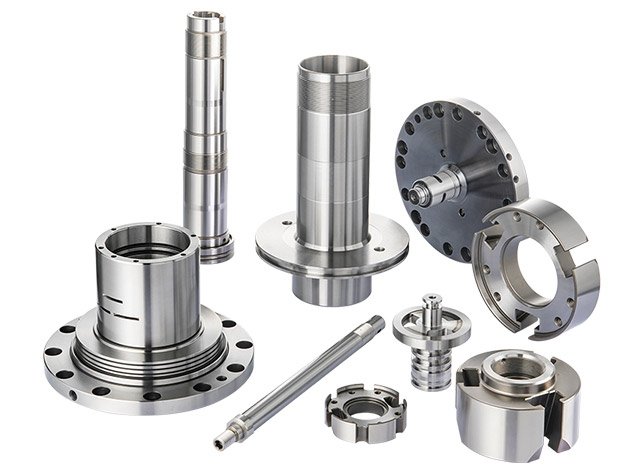
For organizations already sourcing specialized components, Dixin Technology’s broader capabilities can support adjacent programs. Its aerospace CNC machining experience reflects the same discipline in complex geometry, traceability, and high-value materials. Its medical component machining capabilities demonstrate the importance of documentation and controlled processes, while its hydraulic pump parts expertise is relevant to precision bores, sealing interfaces, and fluid-control surfaces.
4. Industry Applications
Precision-machined EV motor housings are used in battery-electric passenger vehicles, commercial vans, buses, electric trucks, off-highway vehicles, and hybrid powertrains. The requirements vary by application, but the central objective remains consistent: maintain the motor’s mechanical and thermal relationships under dynamic loads and changing temperatures.
In passenger vehicles, compact housings may integrate the electric motor, reduction gearbox, inverter mounting, oil cooling, and differential interfaces. This high level of integration makes datum control and leak prevention especially important. A machining error at one interface can affect multiple downstream assemblies, increasing rework and end-of-line testing costs.
Commercial vehicles and buses often prioritize continuous-duty performance, serviceability, and long operating cycles. Their housings may require stronger mounting structures, larger bearing interfaces, and robust cooling passages. Stable machining processes help control fatigue-sensitive features and ensure consistent assembly across high-mileage platforms.
Off-highway and industrial electric drives can experience shock, vibration, dust, moisture, and variable loading. Housing designs may use reinforced ribs, specialized seals, and rugged mounting points. CNC machining must preserve these features without creating burrs, thin-wall distortion, or local stress concentrations.
Hybrid systems and electric auxiliary drives introduce additional applications, including compressor housings, pump bodies, actuator enclosures, and e-axle components. These parts frequently share the same manufacturing priorities: accurate bores, reliable sealing, controlled surface finish, and traceable production. A supplier with cross-industry experience can transfer lessons from fluid-control, drivetrain, aerospace, and medical machining into EV programs.
When evaluating potential suppliers, OEM and Tier 1 teams should provide the 3D model, drawing, material specification, annual volume, forecast profile, critical characteristics, inspection expectations, surface-treatment requirements, and target launch date. The supplier should return a clear review of tolerances, manufacturing risks, inspection methods, lead time, tooling investment, and cost drivers. This early exchange prevents avoidable redesign and establishes a realistic path to production.
5. Call to Action
Precision CNC machining for EV motor housings requires more than advanced equipment. It requires engineering judgment, controlled datums, thermal and distortion management, validated inspection, reliable traceability, and coordinated supply chain execution. The right partner helps transform demanding tolerances into a stable production process that supports performance, cost, and launch objectives.
Discuss your EV motor housing, e-axle enclosure, gearbox housing, or related precision component with Dixin Technology and IndustryApex CNC. Visit the IndustryApex CNC home page to review manufacturing capabilities, or contact the engineering team with your drawings, 3D files, specifications, and production requirements. With more than 30 years of manufacturing experience and an integrated ODM and supply chain approach, Dixin Technology can help you build a precise, scalable, and dependable path from prototype to production.