
- Shaft
- Molds&Tools
- Hydraulics And Pump
- Hair transplant needle
- Hydraulics And Pump
- Precision CNC Shaft Machining Manufacturer for High Performance Applications
- Energy Industry CNC Machining Parts Supplier
- Aerospace Structural Components for OEM Programs
- Aerospace Structural Components for OEM Programs
- Automotive & EV CNC Machining Parts Supplier for OEM and Tier 1
- Medical Device CNC Machining Services
Custom Worm Wheel and Worm Gear Manufacturing Techniques for OEM Supply Chains


Custom Worm Wheel and Worm Gear Manufacturing Techniques for OEM Supply Chains
Custom worm wheels and worm gears are critical power transmission components for applications that require controlled speed reduction, high torque multiplication, compact packaging, and reliable motion control. Although the operating principle is straightforward, producing a dependable worm gear set requires close coordination between gear geometry, material selection, heat treatment, machining accuracy, surface finish, lubrication, and inspection.
For global OEMs and Tier 1 suppliers, the manufacturing challenge extends beyond producing individual parts. The supplier must control engineering changes, raw material availability, production scheduling, process capability, quality documentation, and delivery performance. IndustryApex Technology, operating through IndustryApex CNC, supports this broader requirement with custom worm wheel and worm gear manufacturing, precision machining, supply chain coordination, and ODM engineering support.
1. Executive Summary
A worm gear mechanism uses a worm, which resembles a helical screw, to drive a worm wheel. Depending on the number of worm starts and the wheel tooth count, the assembly can deliver substantial reduction ratios in a compact envelope. The geometry also allows many designs to resist back-driving, making worm drives useful in lifting, positioning, indexing, steering, actuation, and fluid-control equipment.
Custom manufacturing is necessary when standard catalog components cannot satisfy the required center distance, ratio, torque capacity, mounting envelope, shaft arrangement, operating temperature, noise target, or environmental specification. The critical manufacturing decisions include:
- Defining the correct module or diametral pitch, pressure angle, lead angle, and tooth form.
- Selecting compatible worm and wheel materials to balance wear resistance, strength, friction, and thermal behavior.
- Generating the worm thread and wheel teeth with controlled alignment and repeatable indexing.
- Applying heat treatment and finishing processes without introducing excessive distortion.
- Verifying tooth contact, runout, lead accuracy, hardness, dimensions, and surface condition.
The most effective supply model combines early design-for-manufacturing review with a controlled production system. A qualified partner should be able to translate drawings or performance requirements into a manufacturable design, produce prototypes, validate the process, and scale to repeat production while maintaining traceability. This approach reduces late engineering changes and helps OEM purchasing teams manage total cost rather than only piece price.
2. Technical Deep Dive
Worm Gear Geometry and Performance
The performance of a worm gear pair depends on the relationship between worm lead, wheel tooth count, center distance, and pressure angle. A single-start worm can deliver a high reduction ratio, while multi-start worms generally improve efficiency and permit higher output speed. However, a higher lead angle can reduce the self-locking effect and alter sliding velocity, so the design must reflect the actual duty cycle and safety requirements.
Unlike spur or helical gears, worm drives operate with significant sliding between the worm thread and wheel teeth. This sliding action creates heat and places greater importance on lubrication, surface finish, material pairing, and contact pattern. A design that performs acceptably at intermittent low loads may fail under continuous duty if thermal dissipation and tooth flank durability are not properly evaluated.
Engineering review should address transmitted torque, input speed, output speed, shock loading, duty cycle, allowable backlash, ambient contamination, lubrication method, and expected service life. These factors determine whether the worm wheel should use bronze, specialized brass, iron-based alloys, engineered polymers, or another application-specific material. The worm is often manufactured from a hardened steel grade, while the wheel material is selected to provide favorable sliding behavior and controlled wear.
Material Selection and Preparation
Material compatibility is central to worm gear reliability. Hardened steel worms paired with bronze wheels are widely used because the combination offers a practical balance of strength, wear resistance, and friction performance. For corrosive environments, stainless steels, nickel-based alloys, coated surfaces, or non-metallic wheel materials may be considered. The final selection must account for lubrication chemistry, temperature, load, speed, and contamination.
Raw material preparation includes certification review, dimensional inspection, cutting allowance planning, and identification control. Forged, rolled, cast, or bar-stock material can produce different grain structures and machining behavior. For critical applications, the supplier should maintain heat-lot traceability from incoming material through machining, heat treatment, final inspection, and shipment.
Worm Manufacturing Techniques
Worms are commonly produced through CNC turning, thread milling, hobbing, or specialized thread-grinding operations. CNC turning establishes the shaft diameter, bearing seats, shoulders, keyways, and datum features. Thread generation then creates the helix and flank profile. The choice between milling, hobbing, and grinding depends on the required accuracy, material hardness, batch size, and production economics.
For prototypes and lower-volume custom parts, multi-axis CNC machining can provide flexibility and reduce dedicated tooling. For repeat production, dedicated hobbing or thread-generation methods may improve throughput and consistency. Hardened worms may require post-heat-treatment grinding to correct distortion and achieve the specified flank finish. Precision grinding is especially valuable where low noise, stable contact, and tight lead accuracy are essential.
Important worm inspection points include major diameter, root diameter, lead, helix angle, thread form, concentricity, axial runout, radial runout, bearing seat geometry, and surface roughness. In-process probing and coordinate measurement can help detect drift before a complete batch is produced.
Worm Wheel Manufacturing Techniques
Worm wheels may be produced from blanks using turning, boring, keyway machining, and tooth generation. The teeth are often cut by hobbing with a tool that represents the mating worm geometry. Accurate setup of the wheel blank, hob, center distance, indexing, and orientation is required to achieve a consistent tooth form and reliable contact pattern.
When a wheel uses a bronze gear rim with a steel hub, the assembly may be manufactured through casting, shrink fitting, brazing, or other approved joining methods before final machining. The hub must remain stable during subsequent tooth cutting and finishing. For molded polymer wheels, mold design, shrinkage control, fiber orientation, and post-molding dimensional stability become equally important.
Tooth flank finishing can include shaving, honing, lapping, or light corrective machining. Lapping may improve mating contact and reduce initial running noise, but it must be controlled because excessive material removal can change backlash and geometry. Final checks normally include tooth thickness, pitch diameter, bore size, keyway position, face width, runout, and wheel-to-worm contact.
Heat Treatment, Grinding, and Surface Engineering
Heat treatment is selected according to the material and functional requirements. Carburizing, nitriding, induction hardening, through hardening, stress relieving, and precipitation treatments can improve wear resistance or dimensional stability. The process must be matched to the geometry because thin sections, long shafts, and asymmetric hubs are vulnerable to distortion.
After heat treatment, grinding or corrective finishing may be required on bearing seats, reference diameters, thread flanks, and other precision surfaces. Grinding parameters must be managed to avoid burn, tensile residual stress, and unwanted changes to the tooth profile. For demanding applications, process capability studies and periodic verification of hardness depth, microstructure, and surface integrity provide additional assurance.
Inspection and Functional Validation
Dimensional compliance alone does not guarantee a successful worm drive. A complete validation program can include coordinate measuring machine inspection, gear measurement, hardness testing, roughness measurement, runout analysis, and visual inspection for burrs or grinding defects. Assembly testing can evaluate backlash, torque, noise, temperature rise, efficiency, and contact marking under representative loads.
Inspection data should be linked to the production order and material lot through an ERP-based traceability system. This gives the OEM a usable quality record and allows corrective action to focus on specific machines, tools, batches, or process conditions. Clear acceptance criteria are particularly important when the customer supplies performance targets rather than a complete manufacturing drawing.
3. The ODM & Supply Chain Advantage
Custom worm wheel and worm gear projects often begin with incomplete information: a legacy sample, a worn component, an assembly drawing, a target ratio, or an operational problem. An ODM-capable manufacturing partner can convert this information into a controlled product definition. That may include reverse engineering, material recommendations, tolerance review, prototype production, functional testing, and production documentation.
IndustryApex Technology’s core identity is that of a supply chain integrator and ODM solution provider. This means the engagement can cover more than machining. Engineering, sourcing, process planning, quality control, production scheduling, packaging, and logistics are coordinated within one accountable framework. For purchasing and operations teams, this reduces supplier fragmentation and improves visibility across the order lifecycle.
The company’s manufacturing edge is built around a fully controlled precision manufacturing system supported by ERP and more than 30 years of experience. ERP control supports order status, material planning, work instructions, inspection records, revision management, and delivery coordination. This structure is valuable for OEM programs that require repeatability across multiple purchase orders and strict control of engineering revisions.
IndustryApex Technology’s technical capabilities include 3-axis to 5-axis CNC machining, EDM, precision grinding, and industrial ceramics. These processes allow the supplier to support adjacent components and difficult material requirements rather than treating the worm gear as an isolated part. For example, precision grinding can finish hardened worm surfaces, EDM can address complex details or hard materials, and industrial ceramics can support specialized wear, insulation, thermal, or chemical-resistance requirements.
Manufacturing control is especially important for global OEM and Tier 1 suppliers. These customers typically need stable quality, predictable capacity, engineering responsiveness, export documentation, and a clear escalation path. A structured supplier can help manage prototype approvals, first-article inspection, process validation, corrective actions, and controlled ramp-up. It can also support design changes without losing the historical record of the prior configuration.

Supply chain planning should begin with demand characteristics. Low-volume custom components may benefit from flexible CNC processes and scheduled safety stock. Higher-volume programs may justify dedicated tooling, optimized fixtures, automated inspection, or a blanket-order arrangement. In both cases, lead time is influenced by material procurement, heat-treatment availability, tool life, inspection capacity, and packaging requirements, not simply by cutting time.
A strong supplier relationship also improves total cost of ownership. Better tooth contact can extend service life, controlled surface finish can reduce friction and heat, and stable dimensions can simplify assembly. Engineering collaboration may eliminate unnecessary tolerances, reduce secondary operations, and improve manufacturability without compromising function. These savings are often more significant than a small difference in quoted unit price.
4. Industry Applications
Worm gear assemblies are used across industries because they offer compact reduction and controlled rotary motion. Their suitability depends on load, speed, thermal conditions, efficiency expectations, and maintenance practices.
Automation and Positioning Equipment
Automation systems use worm drives in rotary tables, indexing mechanisms, conveyors, actuators, and adjustable fixtures. Compact packaging and controlled backlash can simplify machine layouts. Custom dimensions are often required to match existing motor interfaces, gearbox housings, sensors, and safety enclosures.
Construction and Agricultural Machinery
Construction and agricultural equipment may use worm gear components in steering, adjustment, lifting, metering, and attachment systems. These environments expose parts to vibration, dirt, moisture, shock loads, and variable maintenance. Material selection, sealing, surface treatment, and robust inspection are important for field reliability. Related precision components can be reviewed through IndustryApex Technology’s hydraulics and pump parts manufacturing resources.
Aerospace and Defense Equipment
Aerospace applications demand controlled weight, traceability, dimensional accuracy, and strict documentation. Worm mechanisms may be used in ground-support equipment, actuation systems, positioning devices, or specialized test equipment. When the project involves complex aircraft components or titanium parts, OEM teams can also review the company’s aerospace CNC machining capabilities.
Medical and Laboratory Equipment
Medical and laboratory equipment may use compact worm drives for table adjustment, positioning, dosing, imaging accessories, and controlled movement. Cleanability, corrosion resistance, low noise, and repeatable motion are common priorities. For related high-precision device components, implants, and surgical instruments, the medical CNC machining service provides relevant manufacturing context.
Fluid Control and Process Equipment
Valve actuators, pump systems, dampers, and process-control equipment use worm mechanisms where controlled positioning and mechanical advantage are required. In these applications, corrosion resistance, sealing interfaces, operating temperature, and compatibility with the working fluid must be considered alongside gear performance.
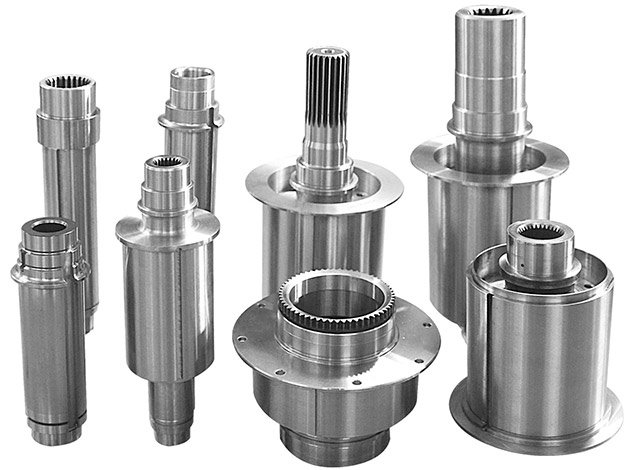
Across each sector, the best results come from involving the manufacturing partner before the design is frozen. Early review can confirm whether the proposed tooth geometry, materials, tolerances, inspection plan, and production route are suitable for the intended service conditions.
5. Call to Action
Custom worm wheel and worm gear manufacturing requires more than accurate cutting. It requires coordinated engineering, material control, heat treatment, finishing, inspection, and delivery planning. IndustryApex Technology combines ODM support, precision machining, ERP-controlled production, and supply chain integration to help global OEMs and Tier 1 suppliers develop and scale reliable transmission components.
Share your drawings, samples, performance requirements, material specifications, or current sourcing challenges with the IndustryApex CNC team. IndustryApex Technology can review manufacturability, recommend an appropriate production route, and develop a quotation aligned with your quality and delivery requirements. Visit the IndustryApex CNC home page to review manufacturing capabilities, or contact the team to begin a custom worm gear project.