- Shaft
- Molds&Tools
- Hydraulics And Pump
- Hair transplant needle
- Hydraulics And Pump
- Precision CNC Shaft Machining Manufacturer for High Performance Applications
- Energy Industry CNC Machining Parts Supplier
- Aerospace CNC Machining Parts Manufacturer
- Aerospace CNC Machining Parts Manufacturer
- Automotive & EV CNC Machining Parts Supplier for OEM and Tier 1
- Medical CNC Machining Parts Supplier for Precision Medical Devices
Custom Worm Wheel and Worm Gear Manufacturing Techniques for OEM Supply Chains

Custom Worm Wheel and Worm Gear Manufacturing Techniques for OEM Supply Chains
Custom worm wheel and worm gear sets remain essential wherever compact right-angle motion transfer, high reduction ratios, controlled output speed, and dependable holding capability are required. For global OEMs and Tier 1 suppliers, selecting a manufacturing partner is not simply a sourcing decision. It is a technical and supply chain decision involving geometry control, material compatibility, heat treatment, surface finish, inspection strategy, traceability, and repeatable delivery.
Dixin Technology, operating through IndustryApex CNC, provides integrated precision manufacturing and ODM support for engineered transmission components. A successful worm gear program begins by translating functional requirements into manufacturable specifications, then controlling each production stage from raw material through final inspection and shipment.
1. Executive Summary
A worm gear drive consists of a screw-like worm and a mating worm wheel. Its crossed-axis design enables substantial speed reduction in a small envelope, typically with shafts arranged at 90 degrees. The system can provide smooth motion and, depending on lead angle, friction conditions, and loading, may offer resistance to back-driving. These characteristics make custom worm gear assemblies valuable in automation, valve actuation, packaging equipment, construction machinery, energy systems, medical devices, aerospace support equipment, and fluid-control applications.
However, worm gear performance is highly sensitive to manufacturing accuracy. Small deviations in lead, pitch, helix angle, tooth form, center distance, concentricity, or flank finish can raise friction, noise, backlash variation, and wear. Material pairing is equally important. Hardened alloy-steel worms are often matched with bronze worm wheels to reduce galling and promote stable sliding contact, while steel, stainless steel, aluminum bronze, engineering polymers, and specialized materials may be selected for particular environments, loads, lubrication systems, or corrosion requirements.
For OEM procurement teams, the strongest custom manufacturing programs combine engineering review with controlled production. The supplier must verify the intended ratio, torque, duty cycle, backlash target, lubrication method, operating temperature, mounting interface, and inspection requirements before production begins. This approach reduces late-stage design changes and provides a clearer path from prototype approval to scalable serial supply.
2. Technical Deep Dive
Worm and worm wheel manufacturing begins with the functional geometry. Critical design inputs include the number of worm starts, worm wheel tooth count, normal module or diametral pitch, pressure angle, lead angle, center distance, face width, gear ratio, allowable backlash, and load spectrum. A one-start worm can achieve high reduction ratios and greater potential for self-locking behavior, while multi-start worms increase output speed and efficiency but may reduce resistance to back-driving. Engineers should assess the complete operating system rather than selecting a ratio in isolation.
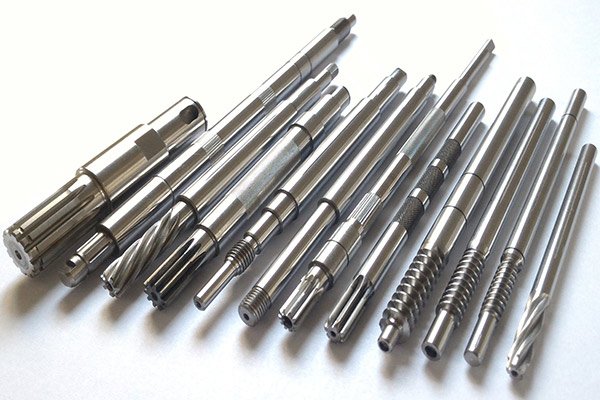
The worm is commonly produced from alloy steel, stainless steel, or other high-strength grades. Manufacturing routes may include CNC turning for the shaft and blank, thread milling, whirling, hobbing, precision grinding, and subsequent finishing of bearing journals or mounting features. For demanding drives, the worm thread is generated or ground after heat treatment to correct distortion and achieve the required lead accuracy and flank finish. Precision grinding is particularly valuable where contact pattern, efficiency, low vibration, and service life are critical.
Worm wheels are frequently manufactured from phosphor bronze, aluminum bronze, brass, ductile iron, steel, or engineered polymers. Bronze remains a practical choice for many industrial applications because it works well against a hardened steel worm under lubricated sliding contact. Depending on design and production volume, wheel teeth can be cut by hobbing, milling, shaping, skiving, or specialized generating processes. The wheel hub, bore, keyway, spline, flange, and mounting interfaces can then be machined on multi-axis CNC equipment to maintain positional accuracy relative to the gear teeth.
Material and heat-treatment decisions must be coordinated across the pair. A hardened worm without an appropriate wheel material, surface finish, lubricant, or contact pattern can accelerate wear instead of improving durability. Common worm heat-treatment processes include carburizing, induction hardening, nitriding, and through-hardening, selected according to required hardness depth, core strength, dimensional stability, and distortion tolerance. Bronze wheels generally do not receive hardening treatments comparable to steel worms, but alloy selection, casting quality, grain structure, and machining control strongly influence fatigue resistance and wear behavior.
Tooth contact verification is a core manufacturing discipline. After machining, the worm and wheel should be assembled at the specified center distance and evaluated for contact pattern, backlash, rotational torque, runout, and smoothness through the intended mesh cycle. Blueing compound or digital contact assessment can reveal whether engagement is centered and adequately distributed across the tooth face. Localized contact may indicate a problem with lead, center distance, wheel geometry, alignment, bearing seats, or housing interfaces.
Inspection requirements should be defined early. Typical controls include incoming material certification, chemical composition verification where required, hardness testing, dimensional inspection of journals and bores, runout measurement, lead and pitch validation, tooth thickness checks, profile measurement, surface roughness inspection, and final functional mesh testing. Coordinate measuring machines, gear inspection equipment, optical systems, and calibrated gauges can be combined according to tolerance and volume. For traceable OEM production, inspection results should connect to lot records and controlled revision data.
Lubrication is also part of the engineering specification. Worm drives operate with significant sliding motion, and lubricant viscosity, additive package, temperature stability, contamination control, and replenishment intervals affect both efficiency and wear. A gear pair that performs well during a short bench test may fail prematurely in service if lubrication, sealing, thermal dissipation, or duty cycle assumptions were incomplete. Dixin Technology reviews these interfaces when supporting custom component development.
3. The ODM & Supply Chain Advantage
Dixin Technology is positioned as a supply chain integrator and ODM solution provider for global OEMs and Tier 1 suppliers. This model extends beyond producing a drawing-defined part. It connects design-for-manufacturability feedback, process planning, material sourcing, prototype builds, quality documentation, production scheduling, and logistics into one coordinated precision manufacturing program.
With more than 30 years of manufacturing experience and a fully controlled precision manufacturing system supported by ERP management, Dixin Technology helps customers improve visibility across complex custom component orders. ERP-supported controls help align material status, work orders, process routing, inspection records, delivery planning, and revision management. This is especially important for worm gear projects that may involve multiple controlled operations, such as blank preparation, heat treatment, precision grinding, tooth generation, deburring, surface treatment, assembly verification, and protective packaging.
The manufacturing platform includes 3-axis to 5-axis CNC machining, EDM, precision grinding, and industrial ceramics capabilities. These resources support the interconnected features commonly found in custom worm gear assemblies: gear teeth, helical forms, bores, shafts, bearing locations, complex mounting surfaces, sealing grooves, keyways, splines, and precision housings. EDM can support complex or hardened features where conventional cutting is inefficient, while precision grinding enables tighter control of critical worms, journals, and mating surfaces. Industrial ceramic capabilities also provide options for specialized wear, insulation, corrosion, or high-temperature applications where metallic solutions may not satisfy system demands.
ODM participation adds value when the initial requirement is functional rather than fully detailed. A customer may provide torque, envelope, duty cycle, mounting constraints, operating medium, and target life, while Dixin Technology assists in developing the component specification. Practical recommendations can include material alternatives, changes in face width, tolerance rationalization, bearing interface adjustments, lubrication provisions, manufacturable tooth geometry, and inspection criteria. The objective is to preserve required performance while reducing avoidable machining complexity, yield loss, and supply risk.
Supply chain resilience depends on controlled sourcing as much as machine capability. Qualified material sources, alternative approved supply paths, batch traceability, standardized quality plans, and realistic lead-time planning reduce exposure to inconsistent raw material or capacity interruptions. For production programs, customers benefit from clear prototype-to-production gates, first article inspection, documented change control, and packaging methods that protect machined teeth and precision surfaces during international transit.
4. Industry Applications
Custom worm gears support a wide range of industrial systems because their compact reduction capability can be adapted to distinct torque, environmental, and integration requirements. In factory automation, worm drives are used in indexing mechanisms, lift systems, positioners, conveyors, robotic auxiliary axes, and guarded adjustment mechanisms. These systems commonly prioritize predictable backlash, controlled motion, low noise, and reliable repeatability.
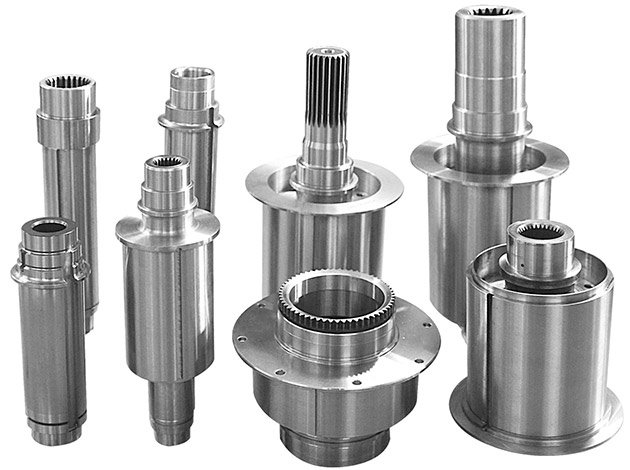
In hydraulics, pumping, and fluid-control equipment, worm gear mechanisms can drive manual or motorized valve actuators, metering systems, flow-control devices, and pump-related adjustment assemblies. Components may require corrosion-resistant materials, sealing-compatible interfaces, and stable performance in the presence of hydraulic fluids or outdoor environments. Dixin Technology also supports custom hydraulic pump parts where precision shafts, housings, sleeves, and transmission-related components must operate together.
Aerospace programs may use worm gear concepts in ground support equipment, positioning systems, test fixtures, cabin mechanisms, and selected aircraft subsystems subject to applicable engineering and qualification requirements. These applications demand disciplined material traceability, controlled processes, lightweight design considerations, and documentation. Learn more about Dixin Technology’s aerospace CNC machining and aircraft structural component capabilities.
Medical and laboratory equipment can use compact worm drives in diagnostic platforms, imaging support devices, sample-handling equipment, controlled adjustment mechanisms, and surgical or rehabilitation equipment. Here, cleanability, corrosion resistance, low particulate generation, controlled motion, and biocompatibility of adjacent components may influence the design. Related requirements can be supported through ISO-certified CNC machining for medical components.
Other common sectors include energy equipment, packaging machinery, agricultural equipment, construction machinery, food-processing systems, and heavy-duty industrial transmissions. Each requires a different balance of torque capacity, efficiency, backlash, wear resistance, corrosion protection, and cost. A qualified manufacturing partner should align the process route to the actual service conditions instead of treating every worm gear as a standard catalog part.
5. Call to Action
For custom worm wheel and worm gear programs, early technical alignment prevents costly revisions later in the supply cycle. Dixin Technology can evaluate drawings, 3D models, material requirements, tolerance stacks, gear ratio targets, inspection plans, and production-volume forecasts to establish a practical manufacturing route. Whether the requirement is a prototype, a low-volume engineered assembly, or an ongoing OEM production program, IndustryApex CNC provides integrated manufacturing and ODM support for precision transmission components.
Contact Dixin Technology to discuss your worm gear design, RFQ, quality requirements, and supply chain objectives.