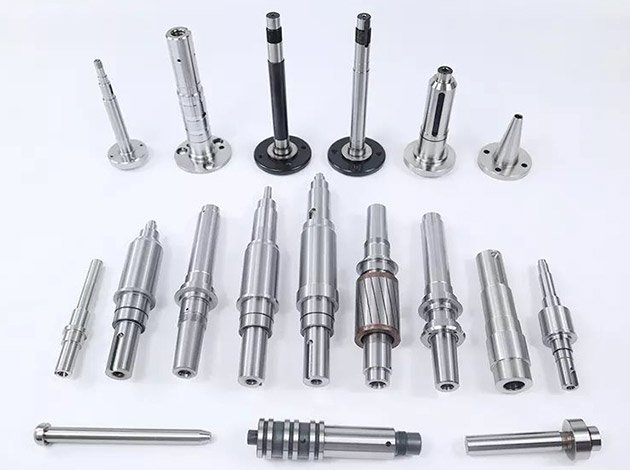
- Shaft
- Molds&Tools
- Hydraulics And Pump
- Hair transplant needle
- Hydraulics And Pump
- Precision CNC Shaft Machining Manufacturer for High Performance Applications
- Energy Industry CNC Machining Parts Supplier
- Aerospace CNC Machining Parts Manufacturer
- Aerospace CNC Machining Parts Manufacturer
- Automotive & EV CNC Machining Parts Supplier for OEM and Tier 1
- Medical CNC Machining Parts Supplier for Precision Medical Devices
How ERP Systems Ensure Quality Control in CNC Mass Production


How ERP Systems Ensure Quality Control in CNC Mass Production
In CNC mass production, quality control is not a final inspection activity. It is a data-driven operating system that must connect customer requirements, process planning, machine execution, inspection results, traceability, and corrective action. Enterprise Resource Planning (ERP) systems provide that backbone. When deployed correctly, ERP turns quality from a downstream filter into a controlled workflow across procurement, scheduling, machining, metrology, packaging, and shipment.
1. Executive Summary
For OEMs and Tier 1 suppliers, CNC quality control has to work at scale. A single conforming part is not enough; the full batch must meet dimensional, material, surface finish, and documentation requirements with low variation and complete traceability. ERP systems help achieve this by linking part numbers, bills of materials, routings, supplier lots, machine records, inspection plans, and nonconformance management in one controlled environment.
That integration matters because production quality issues in CNC operations usually come from broken handoffs: incorrect revision control, mismatched tooling, missing calibration data, uncontrolled material substitutions, or inspection gaps between shifts. ERP reduces those risks by enforcing standardized workflows and by making quality data visible across departments. The result is better first-pass yield, faster containment when issues appear, and lower total cost of poor quality.
For companies sourcing through Dixin Technology, ERP-enabled manufacturing is especially important in high-mix, high-precision programs where aerospace, medical, hydraulic, and other demanding sectors require repeatable execution at volume.
2. Technical Deep Dive
ERP supports quality control in CNC mass production by controlling the complete digital thread from order entry to final shipment. The system does not replace SPC, CMM, or machine-level controls; instead, it coordinates them so that the right specification, process, and inspection logic is applied to each production lot.
At the front end, ERP locks the production order to a specific revision of the part definition. This prevents an older drawing, outdated tolerance, or superseded inspection plan from entering the shop floor. In precision machining, that is critical because even a small revision error can create scrap across an entire batch. ERP also links customer-specific requirements, packaging rules, and certificate needs to the order so operators and inspectors work from the same source of truth.
Next, ERP connects materials and suppliers to traceability records. Raw stock, forgings, castings, ceramics, or bar material can be assigned lot numbers, heat numbers, and vendor certificates before release to machining. If a defect is later found, the manufacturer can identify the affected lots immediately and isolate only the impacted inventory instead of stopping unrelated production. That containment capability is one of the strongest quality advantages in mass production.
On the shop floor, ERP supports machine loading, work center dispatch, and tool control. When integrated with MES or machine data collection, it can verify which machine, program version, fixture, and operator were used for a particular batch. This matters because the root cause of a quality deviation is often tied to process conditions rather than the drawing alone. With disciplined data capture, manufacturers can compare performance across shifts, machines, and programs and identify drift before it becomes systemic.
Inspection planning is another major function. ERP can drive in-process checks, first article inspections, incoming inspection, and final inspection as defined quality gates. For CNC mass production, that means measurement frequency can be matched to process capability. Stable processes may require only periodic sampling, while critical characteristics can be checked at tighter intervals. The inspection results then feed back into the record for lot release and customer documentation.
ERP also strengthens nonconformance management. When a part fails dimensional or visual inspection, the system can trigger quarantine, deviation approval, rework routing, or corrective action workflows. Managers see the defect trend by part number, machine, supplier, or operator, which helps them determine whether the issue is isolated or structural. Without this discipline, factories tend to react inconsistently and lose time chasing symptoms instead of causes.
For regulated industries such as aerospace and medical, ERP makes audit readiness practical rather than manual. Certificates of conformity, process records, inspection logs, and material genealogy can be assembled from the system instead of reconstructed from paper archives. That improves customer confidence and shortens response time during audits or quality reviews. It also supports continuous improvement because the historical data becomes a usable engineering asset.
In practice, the strongest ERP deployments also support statistical visibility. Control charts, yield reporting, rework rates, and on-time corrective action closure can be monitored by product family or customer program. That helps engineering and supply chain teams see where process capability is strong, where it is drifting, and where investment should be directed. The better the data discipline, the easier it is to keep CNC mass production within specification without over-inspecting every piece.
3. The ODM & Supply Chain Advantage
Dixin Technology operates as a supply chain integrator and ODM solution provider, which gives ERP a broader role than simple production tracking. In this model, ERP coordinates not only machining, but also sourcing, routing, capacity planning, packaging, and export documentation across a fully controlled precision manufacturing system. That is the difference between a shop that merely processes orders and a manufacturing partner that can own program execution end to end.
The manufacturing edge is built on more than 30 years of experience and a controlled operating system that combines ERP with tightly managed production and inspection flows. For global OEMs and Tier 1 suppliers, that experience matters because mass production quality is a supply chain problem as much as a machining problem. Lead time, supplier consistency, change control, and factory discipline all influence whether the delivered part is conforming.
ERP also enables Dixin Technology’s wider process capability set, including 3-axis to 5-axis CNC, EDM, precision grinding, and industrial ceramics. Each process brings its own quality risks and control methods. Multiaxis machining requires program control and setup discipline; EDM depends on stable parameters and electrode management; grinding requires tight control of finish and geometry; ceramics require material handling and dimensional consistency that are more demanding than standard metal parts. ERP allows those routes to be managed under one quality framework.
This is especially valuable when programs move between industries. A customer in aerospace may require serialized traceability and full inspection packs, while a medical customer may focus on process validation and clean documentation, and a hydraulics customer may prioritize repeatability and sealing surfaces. ERP helps tailor the control plan without breaking the underlying manufacturing system.
For buyers evaluating partners, Dixin Technology’s approach can be reviewed through the Contact Us page, or by looking at capability-specific programs such as Aerospace Parts, Medical Parts, and Hydraulics & Pump applications. Each category reflects a different quality profile, but all benefit from the same ERP discipline.
For supply chain leaders, the real advantage is resilience. ERP makes it easier to absorb engineering changes, shift demand, qualify alternate material flows, and keep production visible when customer requirements change. That visibility is what turns quality control into a managed business capability rather than a shop-floor reaction.
4. Industry Applications
ERP-driven quality control is most valuable where tolerances are tight, volumes are significant, and failure costs are high. In aerospace manufacturing, ERP supports complete traceability for structural components, titanium parts, and high-risk assemblies. The system helps ensure that each lot is tied to controlled material, qualified processes, and document sets that can stand up to customer and regulatory scrutiny.
In medical manufacturing, the focus shifts to consistency, clean documentation, and reliable process execution. ERP helps manage approved materials, inspection intervals, and lot history so that surgical instruments, implant-related components, and precision device parts are produced under a controlled framework. The ability to retrieve production history quickly is especially important when customers demand evidence rather than verbal assurance.
In hydraulics and fluid power, quality control centers on functional repeatability. Valves, pump components, and sealing interfaces must hold geometry across production runs because a small machining error can affect leakage, wear, or pressure performance. ERP supports this by controlling process routing, inspection plans, and corrective actions when variation appears.
Across these industries, the pattern is the same: the product may change, but the quality system must remain disciplined. ERP provides that discipline by aligning procurement, engineering, production, and inspection around a shared set of records. That alignment reduces the chance of rework, delays, and shipment risk while strengthening long-term supplier performance.
5. Call to Action
ERP systems ensure quality control in CNC mass production by creating a closed loop between engineering intent, factory execution, inspection evidence, and corrective action. For OEMs and Tier 1 suppliers, that closed loop is the difference between managing quality after the fact and preventing defects before they spread.
If your program requires stable output, strict traceability, and a manufacturing partner that can support precision machining at scale, Dixin Technology is positioned to help. Visit the main site to review capabilities, or contact the team to discuss a specific CNC mass production requirement.