- Shaft
- Molds&Tools
- Hydraulics And Pump
- Hair transplant needle
- Hydraulics And Pump
- Precision CNC Shaft Machining Manufacturer for High Performance Applications
- Energy Industry CNC Machining Parts Supplier
- Aerospace CNC Machining Parts Manufacturer
- Aerospace CNC Machining Parts Manufacturer
- Automotive & EV CNC Machining Parts Supplier for OEM and Tier 1
- Medical CNC Machining Parts Supplier for Precision Medical Devices

Precision CNC Machining for EV Motor Housings: Tight Tolerances Explained for OEM Supply Chains

Precision CNC Machining for EV Motor Housings: Tight Tolerances Explained
EV motor housings look simple from the outside, but they are among the most tolerance-sensitive aluminum structures in an electric drivetrain. For global OEMs and Tier 1 suppliers, the housing is not just a protective shell. It is the datum framework that controls stator alignment, rotor air gap, bearing life, sealing performance, thermal transfer, NVH behavior, and final assembly yield. At IndustryApex Technology, operating as IndustryApex CNC, precision CNC machining for EV motor housings is approached as an engineering and supply chain discipline, not only as a machining service.
Executive Summary
As EV platforms move toward higher power density, integrated e-axles, faster motor speeds, and compact packaging, motor housing tolerances have become stricter. A housing that is only slightly out of round can create uneven stator contact, poor heat conduction, rotor imbalance, or excessive bearing load. A bearing bore that drifts from its datum can increase noise and shorten service life. A coolant channel with inconsistent wall thickness can weaken thermal control or increase leakage risk. These are not cosmetic defects; they are functional risks that can affect warranty exposure and production stability.
For purchasing, engineering, and supplier quality teams, the key question is not whether a CNC supplier can cut aluminum. The real question is whether the supplier can control datums, thermal distortion, tool wear, casting variation, process capability, inspection strategy, and batch traceability across prototype, pilot, and mass production stages. EV motor housing machining requires a controlled process chain that links design for manufacturability, fixture engineering, multi-axis CNC programming, in-process probing, coordinate measuring machine inspection, and ERP-driven production control.
This article explains the tolerance logic behind EV motor housings, the machining and inspection choices that protect performance, and the supply chain advantage of working with an ODM and precision manufacturing partner capable of handling complex, high-value components for global programs.
Technical Deep Dive
The most critical geometric feature in an EV motor housing is usually the stator bore. The stator must sit with consistent contact pressure and radial alignment so the motor can maintain a uniform air gap between rotor and stator. In high-speed electric motors, a small eccentricity can translate into vibration, magnetic imbalance, efficiency loss, and audible whine. Typical engineering requirements may include tight roundness, cylindricity, perpendicularity to end faces, and coaxiality relative to bearing seats. The exact tolerance depends on motor architecture, housing size, alloy, assembly method, and thermal profile, but the principle is consistent: the machined housing defines the motor geometry.
Bearing seats are another high-risk feature. The front and rear bearing bores must be controlled for diameter, surface finish, alignment, and positional relationship. If bearing bores are not coaxial, the shaft can be forced into a stressed condition during assembly. That stress may not appear during a basic dimensional check, but it can emerge as higher operating temperature, noise, vibration, premature wear, or seal failure. For this reason, experienced manufacturers do not treat bearing seats as isolated holes. They are machined and inspected as part of a complete datum system.
Flatness and perpendicularity also matter. End faces, cover interfaces, inverter mounting pads, and gearbox connection surfaces often carry sealing or structural loads. A warped face can cause uneven gasket compression, coolant leakage, misalignment with adjacent drivetrain modules, or variation during robotic assembly. In integrated drive units, the motor housing may interface with a reduction gearbox, power electronics, oil circuit, or water jacket. This increases the number of functional surfaces that must be controlled in relation to each other.
Material behavior is a major challenge. EV motor housings are commonly produced from aluminum castings, extrusions, or near-net-shape blanks. Aluminum is attractive because it is lightweight and conducts heat well, but it is also sensitive to clamping force, residual stress, temperature change, and casting inconsistency. Thin-wall housings can deform during rough machining, then relax before finishing. If the process does not account for this, a part may measure correctly at one stage and shift after unclamping or after thermal stabilization.
A robust machining sequence usually separates roughing, semi-finishing, and finishing. Roughing removes bulk material while leaving stock for stress relief and final geometry correction. Semi-finishing prepares critical surfaces and reduces uneven material distribution. Finishing then establishes the final datum features, bores, faces, grooves, threads, and sealing surfaces under stable conditions. For complex housings, 4-axis or 5-axis machining can reduce repositioning error and improve access to angled ports, coolant channels, connector bosses, and mounting features.
Surface finish is equally important. A stator bore may need a controlled texture for press-fit or shrink-fit assembly. Bearing bores require smooth, stable surfaces that hold tolerance without chatter marks. Sealing grooves and O-ring lands need surface quality that supports leak-free operation. Threaded holes, dowel holes, and connector interfaces must be consistent enough for automated assembly. These features require the correct tooling strategy, coolant management, tool life control, and inspection checkpoints.
Tight tolerance machining is not achieved by a final inspection alone. It depends on process capability. A supplier must understand which dimensions are critical to function, which tolerances are process-sensitive, and which features should be measured in-process to prevent scrap. CMM inspection, air gauges, bore gauges, surface roughness testers, thread gauges, and leak test fixtures may all be part of the control plan. For production programs, statistical process control helps identify drift before it causes nonconforming batches.
The engineering culture required for EV motor housings is similar to other precision sectors. Aerospace structural machining demands datum discipline and material stability, which is why many OEM teams benchmark suppliers with experience in aerospace CNC machining and aircraft structural components. Medical device manufacturing also reinforces traceability, validation, and surface integrity, as seen in ISO-certified CNC machining for medical components. EV drivetrain programs benefit when these quality habits are transferred into automotive-scale production.
The ODM & Supply Chain Advantage
For many EV programs, the technical challenge is only one side of the problem. The supply chain challenge is just as important. Motor housings often move through casting, heat treatment, machining, cleaning, surface treatment, inspection, assembly, and packaging. If these steps are managed by disconnected vendors, engineering changes become slow, nonconformance ownership becomes unclear, and delivery risk increases. A supply chain integrator can reduce that friction by managing the complete manufacturing route around a controlled quality plan.
IndustryApex Technology positions IndustryApex CNC as both a precision manufacturing partner and an ODM solution provider. That matters when a customer needs more than build-to-print machining. In early development, the supplier can review drawings, flag tolerance stack-up risks, recommend datum structures, advise on machining allowances, and improve manufacturability without weakening performance. During prototype and pilot stages, feedback from machining, inspection, and assembly can be looped back into design revisions. During production, the same knowledge becomes part of the control plan.
The manufacturing edge comes from a fully controlled precision manufacturing system supported by ERP and more than 30 years of production experience. ERP control is not a marketing detail. For global OEM and Tier 1 suppliers, it affects order visibility, material tracking, routing discipline, capacity planning, revision control, inspection record management, and delivery performance. When an EV program scales, the supplier must repeat the same process thousands of times while maintaining traceable records and fast response to engineering changes.
Technically, EV motor housings benefit from access to 3-axis, 4-axis, and 5-axis CNC machining, EDM, precision grinding, and related high-precision processes. EDM may support features that are difficult to mill conventionally. Precision grinding can support mating components and high-accuracy tooling. Industrial ceramics capability broadens the solution set for wear-resistant, insulating, or thermal applications in adjacent assemblies. The value for the customer is not a single machine type, but the ability to select the right process combination for dimensional accuracy, cost, lead time, and lifecycle performance.
For sourcing teams, this integrated model reduces supplier fragmentation. For engineering teams, it shortens the path between design intent and manufacturable reality. For quality teams, it creates clearer accountability. For operations teams, it improves the chance that prototypes, PPAP samples, and serial production parts are made under a coherent process logic instead of being reinvented at each stage.
Industry Applications
Precision EV motor housing machining supports passenger cars, commercial vehicles, electric buses, e-motorcycles, off-highway electrification, robotics, and industrial motion systems. In passenger vehicles, the focus is often high volume, low noise, weight reduction, and compact e-axle integration. In commercial vehicles, durability, thermal stability, and service life become stronger priorities. In industrial electrification, housings may need heavier structures, custom mounting patterns, or sealed operation in harsh environments.
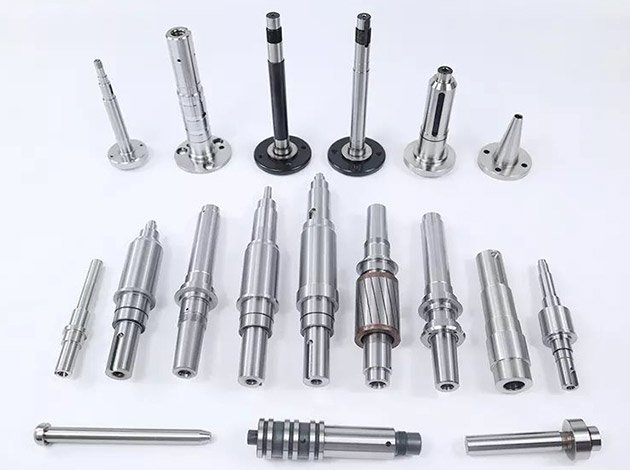
The same tolerance principles apply to related drivetrain parts, including gearbox housings, end covers, rotor shafts, bearing carriers, resolver mounts, cooling plates, and inverter housings. When a manufacturer can control bores, faces, seal lands, ports, and datum relationships across these parts, the customer gains better system-level consistency. This is especially valuable when motor, gearbox, and power electronics are packaged into a single compact drive unit.
EV thermal management also connects with fluid control expertise. Coolant ports, internal channels, valve interfaces, and pump-related housings must be leak-tight and dimensionally stable. Experience with hydraulic pump parts and precision fluid control components is relevant because both fields require sealing reliability, bore quality, and pressure-aware manufacturing discipline.
Across these applications, the supplier selection criteria should be practical. Look for evidence of datum-based machining plans, fixture design capability, inspection depth, process stability, documentation discipline, and responsiveness to engineering changes. A low quote price can become expensive if it creates assembly rework, delayed validation, or field reliability risk. For tight-tolerance EV components, supplier capability should be evaluated through process evidence, not only through sample appearance.
Call to Action
EV motor housings sit at the center of drivetrain performance, thermal control, and assembly reliability. Tight tolerances are not arbitrary drawing requirements; they are the mechanical language that protects efficiency, noise behavior, bearing life, sealing performance, and production yield. The right CNC partner understands how those requirements translate into machining strategy, inspection planning, supply chain control, and scalable execution.
IndustryApex Technology, through IndustryApex CNC, supports global OEM and Tier 1 suppliers with ODM engineering support, controlled precision manufacturing, ERP-managed production, and over 30 years of experience across demanding industries. To discuss an EV motor housing, e-axle component, drivetrain housing, or related precision machining project, contact the IndustryApex CNC engineering team with your drawings, target volumes, material requirements, and quality expectations.