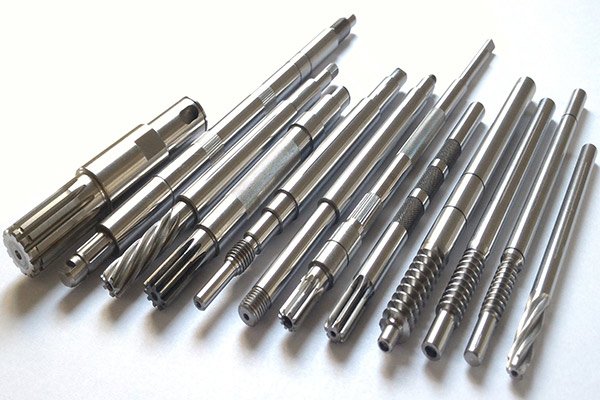
- Shaft
- Molds&Tools
- Hydraulics And Pump
- Hair transplant needle
- Hydraulics And Pump
- Precision CNC Shaft Machining Manufacturer for High Performance Applications
- Energy Industry CNC Machining Parts Supplier
- Aerospace CNC Machining Parts Manufacturer
- Aerospace CNC Machining Parts Manufacturer
- Automotive & EV CNC Machining Parts Supplier for OEM and Tier 1
- Medical CNC Machining Parts Supplier for Precision Medical Devices

Custom Worm Wheel and Worm Gear Manufacturing Techniques for OEM Precision Transmission Systems

Executive Summary
Custom worm wheel and worm gear manufacturing is a specialized discipline where transmission efficiency, load capacity, backlash control, material pairing, and long-term wear behavior must be engineered together. For global OEMs and Tier 1 suppliers, the challenge is not simply buying a gear set; it is building a reliable motion-control subsystem that performs consistently across production batches, operating temperatures, lubrication conditions, and installation environments.
At IndustryApex Technology, operating through IndustryApex CNC, we approach worm gear manufacturing as an integrated engineering and supply chain program. A worm gear set typically consists of a screw-like worm and a mating worm wheel. Because the tooth contact is predominantly sliding rather than rolling, the manufacturing process must control geometry, surface finish, hardness, lubrication compatibility, and tooth bearing patterns with exceptional discipline. Small deviations in lead angle, tooth profile, center distance, or surface roughness can create heat, noise, premature wear, or transmission error.
This article analyzes the key manufacturing techniques behind custom worm wheels and worm gears, including design for manufacturability, material selection, blank preparation, hobbing, thread milling, grinding, EDM support processes, heat treatment, inspection, and supply chain control. It also explains how an ODM manufacturing partner can reduce project risk by aligning engineering, process planning, sourcing, production, inspection, and logistics under one controlled system.
For applications in robotics, packaging equipment, valve actuation, aerospace mechanisms, medical equipment, hydraulic assemblies, industrial automation, and heavy machinery, the business value is clear: a well-engineered worm gear set improves torque transmission, compactness, positioning stability, noise performance, and lifecycle cost. A poorly controlled gear set can become a hidden failure point inside an otherwise high-value machine. That is why global buyers increasingly seek a precision manufacturing partner capable of combining CNC machining, gear process knowledge, metrology, documentation, and scalable supply chain execution.
Technical Deep Dive
Worm gear manufacturing begins with defining the functional requirements of the transmission. Engineers must clarify torque, speed ratio, duty cycle, mounting orientation, lubrication method, allowable backlash, noise level, input speed, thermal limits, and expected service life. These requirements guide choices such as single-start or multi-start worm design, normal module or diametral pitch, lead angle, pressure angle, tooth profile, face width, center distance, and material pairing.
One of the most common engineering strategies is pairing a hardened steel worm with a bronze worm wheel. The steel worm provides wear resistance and dimensional stability, while bronze offers anti-seizure behavior and conformability under sliding contact. However, modern applications may require alternatives such as stainless steel, alloy steel, ductile iron, aluminum bronze, engineering polymers, or advanced surface-treated materials. In corrosive, cleanroom, food-grade, medical, or vacuum environments, material compatibility may matter as much as torque rating.
The first manufacturing stage is blank preparation. Worm wheel blanks are commonly produced by CNC turning to establish the bore, hub, outside diameter, faces, and datum surfaces. If the component includes keyways, splines, bolt circles, flanges, or integrated housings, 3-axis or 5-axis CNC milling may be used before or after gear cutting. Worm shafts require precise turning of journals, thread zones, shoulders, bearing seats, and drive features. Concentricity between the worm thread and bearing journals is critical because misalignment directly affects tooth contact and noise.
Gear tooth generation for worm wheels is commonly performed by hobbing. A hob that corresponds to the worm geometry cuts the wheel teeth while maintaining a synchronized relationship between tool and workpiece. Hobbing is productive and suitable for repeatable production, but it requires careful setup. Tool wear, hob accuracy, workholding stiffness, machine backlash, and coolant strategy all influence the final tooth form. For custom low-volume projects, CNC gear milling or 5-axis machining may also be considered when geometry is complex or when lead time is critical.
Worm manufacturing can involve thread milling, whirling, turning, grinding, or a combination of operations. For high-precision worms, grinding after heat treatment is often used to achieve superior lead accuracy, profile accuracy, and surface finish. A ground worm improves contact stability, reduces noise, and helps manage heat generation under continuous operation. Where cost and duty cycle permit, precision thread milling may provide an effective balance between accuracy and flexibility.
Heat treatment is another decisive variable. Steel worms may be carburized, induction hardened, nitrided, or through hardened depending on the application. The goal is to obtain surface wear resistance while maintaining core toughness and dimensional control. Heat treatment distortion must be anticipated in the process plan. This is why finish grinding, hard turning, or post-heat-treatment inspection is essential for many precision assemblies.
Surface finish deserves special attention because worm gear contact has a high sliding component. A rough worm surface can rapidly wear the mating wheel, while an overly soft wheel may deform under load. Typical engineering controls include tooth flank roughness measurement, contact pattern checks, runout inspection, lead and profile verification, and controlled deburring. Burrs at tooth edges can contaminate lubrication systems or initiate abnormal wear, particularly in compact reducers and sealed gearboxes.
Backlash is not merely a drawing tolerance; it is a system-level design decision. Low backlash may be necessary for positioning applications, robotics, medical motion systems, and optical equipment. However, insufficient backlash can increase heat and cause binding under thermal expansion or misalignment. Higher backlash may be acceptable in general power transmission but can create vibration or positional error. Custom worm gear manufacturing therefore requires close collaboration between design engineers and process engineers to balance function, manufacturability, and cost.
Inspection closes the technical loop. Depending on the criticality of the part, inspection may include CMM measurement, gear measuring center reports, surface roughness testing, hardness testing, material certification, runout inspection, bore-to-tooth concentricity checks, and blue-contact pattern verification. For OEM programs, first article inspection and production part approval documentation can be structured to support repeatable procurement and supplier qualification.
The ODM & Supply Chain Advantage
Many buyers initially treat worm wheels and worm gears as individual machined parts. In practice, they are performance-critical transmission components that require integrated manufacturing management. This is where IndustryApex Technology’s core identity as a supply chain integrator and ODM solution provider becomes strategically important. Instead of separating design feedback, raw material sourcing, gear cutting, heat treatment, grinding, inspection, packaging, and logistics across disconnected vendors, we manage the process as a controlled manufacturing system.
With more than 30 years of precision manufacturing experience, IndustryApex Technology has built a fully controlled production framework supported by ERP-based planning and traceability. ERP control helps align quotation assumptions, engineering revisions, raw material batches, production routing, inspection records, delivery schedules, and repeat orders. For global OEM and Tier 1 customers, this reduces the operational friction that often appears when custom transmission components move from prototype to stable production.
Our manufacturing edge includes 3-axis, 4-axis, and 5-axis CNC machining, EDM, precision grinding, and industrial ceramics capabilities. These technologies allow us to support not only gear teeth but also the surrounding mechanical features that determine assembly performance. A worm wheel may require a precision bore, keyway, spline, mounting flange, lightening pockets, lubrication grooves, or integrated structural features. A worm shaft may require bearing journals, drive flats, internal threads, cross holes, or complex end connections. Managing these features under one technical workflow improves datum control and reduces cumulative error.
EDM can be valuable for difficult internal features, hard materials, sharp corner requirements, and special tooling support. Precision grinding supports hardened surfaces, tight shaft journals, and high-quality worm flanks. Industrial ceramics capability is relevant when customers need wear-resistant, electrically insulating, chemically stable, or thermally stable components within the broader assembly. Although ceramics are not standard for every worm gear set, the ability to integrate ceramic parts can benefit specialized automation, semiconductor, chemical, and medical equipment projects.
The ODM advantage also includes design-for-manufacturing feedback. Early supplier involvement can identify whether a requested tolerance is functionally necessary, whether a material is compatible with lubrication and heat treatment, whether a bore-to-gear datum scheme is inspectable, or whether a tooth modification would improve contact behavior. This prevents expensive redesign after tooling, sampling, or field testing.
For procurement teams, the supply chain advantage is equally important. Custom worm gear programs often involve bronze, alloy steel, stainless steel, heat treatment suppliers, surface treatment, inspection fixtures, export packaging, and recurring forecast management. A single weak link can delay the entire gearbox or machine build. IndustryApex Technology coordinates these elements to support stable delivery, documentation, and cost control. Our role is not only to machine parts but to protect the customer’s production continuity.
For buyers qualifying Asian precision manufacturing partners, risk management should include process capability, engineering communication, revision control, inspection transparency, and scalability. IndustryApex Technology supports prototype, bridge production, and serial production with a manufacturing mindset built for international B2B requirements. Whether the project is a compact actuator gear set or a heavy-duty industrial transmission component, the goal is the same: deliver parts that assemble correctly, run smoothly, and remain repeatable from batch to batch.
Industry Applications
Custom worm wheel and worm gear sets are used wherever compact speed reduction, high torque multiplication, right-angle motion transfer, or self-locking behavior is required. Their application scope spans industrial machinery, mobility systems, energy equipment, automation platforms, and mission-critical engineered products.
In aerospace and defense-related mechanisms, lightweight structures, compact actuation, and reliability are essential. Worm gears may be used in seat actuation, control systems, adjustment devices, ground support equipment, and specialized mechanisms. For customers seeking precision machined structural and motion components, IndustryApex Technology also supports aerospace CNC machining and titanium aircraft parts, where documentation, material control, and geometric precision are fundamental.
In medical and laboratory equipment, worm gear systems may appear in adjustable beds, imaging devices, surgical support systems, diagnostic instruments, dosing mechanisms, and compact positioning modules. These applications often demand smooth motion, low noise, clean surfaces, corrosion resistance, and strict traceability. IndustryApex Technology’s experience with ISO-certified CNC machining for medical components supports the quality mindset needed for high-precision device parts and regulated supply chains.
Hydraulic and pump systems can use worm gear mechanisms in valve actuation, flow control adjustment, metering systems, and auxiliary drives. In these environments, torque reliability, corrosion resistance, sealing compatibility, and stable operation under vibration are important. Our related capabilities in hydraulic pump parts demonstrate how precision machining, surface finish, and dimensional control support fluid power applications.
Industrial automation and robotics require compact reducers, controlled backlash, and repeatable motion. Worm gear sets may be used in indexing tables, conveyors, packaging machines, grippers, lifting columns, rotary actuators, and servo-assisted mechanisms. While harmonic and planetary reducers are common in high-end robotics, worm gears remain valuable where right-angle layout, holding force, cost efficiency, or mechanical simplicity is preferred.
Automotive and mobility systems may use worm gears in steering systems, seat adjusters, window mechanisms, lift systems, charging equipment, and special vehicle actuators. These applications require stable production quality and noise control. Because automotive buyers often operate under strict cost, delivery, and batch consistency expectations, ERP-managed manufacturing and mature process planning become major advantages.
Construction machinery, agricultural equipment, and heavy industrial systems use worm gears for adjustment drives, hoists, gate mechanisms, winches, and positioning systems. These parts face shock loads, contamination, variable lubrication, and harsh operating environments. Material selection, tooth strength, protective coatings, and robust inspection are essential to prevent early failure.
Energy, packaging, food processing, marine, and chemical equipment can also require custom worm gear components. In these sectors, stainless steels, bronze alloys, special coatings, or sealed lubrication strategies may be necessary. The ability to customize geometry, material, and finishing allows OEMs to design around real operating conditions instead of forcing a catalog gear into a demanding application.
Call to Action
Custom worm wheel and worm gear manufacturing is most successful when engineering, machining, heat treatment, grinding, inspection, and supply chain control are aligned from the beginning. If your team is developing a new gearbox, improving an existing actuator, localizing a transmission component, or searching for a stable OEM manufacturing partner, IndustryApex Technology can support your project from design review to production delivery.
As IndustryApex CNC, we combine more than 30 years of manufacturing experience with 3-5 axis CNC machining, EDM, precision grinding, industrial ceramics capability, ERP-controlled production, and ODM supply chain integration. Our target customers include global OEMs and Tier 1 suppliers that need more than a part supplier; they need a manufacturing partner capable of protecting quality, lead time, and long-term repeatability.
To discuss your worm gear drawings, material requirements, target backlash, inspection standards, or production forecast, contact IndustryApex Technology for an engineering and supply chain review. The earlier we are involved, the more opportunities we have to optimize manufacturability, cost, durability, and delivery performance.