
- Shaft
- Molds&Tools
- Hydraulics And Pump
- Hair transplant needle
- Hydraulics And Pump
- Precision CNC Shaft Machining Manufacturer for High Performance Applications
- Energy Industry CNC Machining Parts Supplier
- Aerospace Structural Components for OEM Programs
- Aerospace Structural Components for OEM Programs
- Automotive & EV CNC Machining Parts Supplier for OEM and Tier 1
- Medical Device CNC Machining Services
Large-Scale Machining Analysis: Gantry Milling, Crankshaft Grinding, and Global OEM Supply Chains

Large-Scale Machining: Gantry Milling and Crankshaft Grinding
Large-scale machining is a critical manufacturing capability for OEMs and Tier 1 suppliers producing engines, industrial equipment, energy systems, hydraulic assemblies, aerospace structures, and other products that depend on dimensional stability and long service life. Within this category, gantry milling and crankshaft grinding address two different but complementary production challenges: the accurate machining of large structural workpieces and the controlled finishing of long, rotational components.
For global buyers, the technical process is only one part of the sourcing decision. Equipment capacity, process control, inspection discipline, engineering communication, material traceability, production planning, and logistics determine whether a supplier can support a repeatable program. This article examines the engineering requirements behind gantry milling and crankshaft grinding, then explains how an integrated ODM and supply chain partner can reduce technical and commercial risk.
1. Executive Summary
Gantry milling is designed for large and heavy components that exceed the practical envelope of conventional vertical or horizontal machining centers. A rigid gantry structure supports the cutting head over a fixed table or moving work platform, allowing manufacturers to machine long beds, frames, housings, structural plates, molds, and precision equipment bases. Typical operations include face milling, contouring, pocketing, drilling, tapping, and five-axis machining of complex surfaces.
Crankshaft grinding serves a different purpose. After forging, casting, or rough machining, the crankshaft requires highly controlled grinding of main journals, crankpins, thrust surfaces, fillets, and sometimes counterweight-related features. The objective is not simply to achieve a nominal diameter. The grinding process must control roundness, cylindricity, taper, surface roughness, journal-to-journal relationships, stroke geometry, phase angle, and the transition between journals and fillets.
Both processes are sensitive to vibration, thermal growth, workholding, tool or wheel condition, and measurement strategy. A capable supplier therefore manages the entire process chain, from drawing and material review through programming, fixturing, roughing, finishing, inspection, documentation, packaging, and delivery. For buyers seeking a dependable manufacturing partner, IndustryApex Technology, operating through IndustryApex CNC, provides access to a controlled precision manufacturing system for complex, high-value components. The company supports global OEM and Tier 1 requirements through engineering coordination, production management, and supply chain integration.
2. Technical Deep Dive
Gantry Milling for Large and Complex Workpieces
A gantry machining center uses a bridge-style structure that spans the work area. The bridge may carry one or more ram-mounted cutting heads, while the table or workpiece moves along the longitudinal axis. This architecture provides a practical combination of working envelope, rigidity, and accessibility for parts that are too large, long, or heavy for standard equipment.
Rigidity is fundamental. Large workpieces can generate substantial cutting forces, particularly when removing scale, forged stock, or excess weld material. Any deflection in the machine structure, fixture, tool, or workpiece can transfer directly into dimensional error. Engineers must therefore assess the load path from the spindle through the tool, workholding system, and supporting table. Cutting parameters are selected to balance material removal rate with vibration control, tool life, and surface quality.
Workholding is often more complicated than the cutting operation. A long frame or welded assembly may have residual stress and may distort when material is removed. The fixture must provide adequate support without over-constraining the part. Adjustable supports, datum pads, modular clamps, and stress-relief procedures may be required. For castings and fabricated structures, the manufacturing plan should identify datum surfaces early and define how the component will be re-established if it must be removed and reloaded.
Thermal behavior also affects large-format machining. Extended cycles can create temperature gradients across the machine, workpiece, and shop environment. A precision supplier may use warm-up routines, coolant management, temperature monitoring, controlled sequencing, and in-process checks to reduce thermal drift. Finishing passes are commonly separated from aggressive roughing so that the final geometry is established after the largest cutting forces and heat inputs have been removed.
Gantry milling is especially valuable when a component requires multiple operations to remain aligned within a common coordinate system. Drilling, counterboring, pocketing, face milling, and contour machining can be completed with fewer setup changes. This reduces accumulated datum error and simplifies inspection. For complex aerospace structures and large equipment components, five-axis capability can improve tool access and maintain a more consistent tool orientation across contoured surfaces. IndustryApex Technology’s aerospace CNC machining capabilities are relevant when large structural components require demanding material control and multi-axis access.
Crankshaft Grinding and Geometric Control
Crankshaft grinding is a precision finishing operation in which abrasive wheels remove a controlled amount of material from cylindrical and offset journals. The crankshaft is supported and rotated while the grinding wheel follows the programmed journal geometry. Because the crankpins are offset from the main axis, the machine must coordinate rotation and wheel movement accurately throughout the cycle.
The first engineering decision is process condition. A crankshaft may require rough grinding, semi-finishing, finish grinding, polishing, fillet rolling, balancing, and non-destructive inspection. The sequence depends on the material, heat treatment, size, journal geometry, production volume, and performance requirements. Grinding allowances must be sufficient for stock removal while avoiding unnecessary cycle time and excessive thermal load.
Burn prevention is a central concern. Excessive heat at the grinding zone can alter the metallurgical condition of the journal surface, producing grinding burn, residual tensile stress, or microcracking. Wheel specification, dressing frequency, coolant delivery, grinding depth, feed rate, and spark-out time all influence thermal control. A stable process uses appropriate coolant flow at the contact zone rather than relying solely on general flooding around the machine.
Geometric inspection must extend beyond journal diameter. Critical characteristics include roundness, taper, cylindricity, surface roughness, concentricity between main journals, crankpin offset, stroke, fillet radius, phase angle, and axial location. Depending on the application, inspection may use precision gauges, air gauging, coordinate measurement, roundness measurement, profilometry, magnetic particle inspection, and dynamic balancing equipment.
Grinding quality also depends on the condition of the component before finishing. Forging defects, decarburization, heat-treatment distortion, straightness variation, and machining marks can affect the final result. A robust manufacturing plan defines incoming inspection and establishes a clear response when the actual stock condition differs from the drawing assumption. This is particularly important for replacement crankshafts, low-volume industrial engines, and custom shaft components where each part represents a significant share of the program cost.
For both gantry milling and crankshaft grinding, digital process documentation improves repeatability. CNC programs, revision-controlled drawings, tool or wheel records, setup sheets, inspection reports, and material certificates should be connected to the production order. An ERP-supported system helps link engineering changes, procurement, capacity planning, quality records, and shipment status.
3. The ODM & Supply Chain Advantage
Large-scale machining programs often fail at the interfaces between engineering, purchasing, production, quality, and logistics. A supplier may have a suitable machine but lack the planning discipline to control material availability, outside processing, inspection timing, or export documentation. For OEM and Tier 1 customers, the preferred model is a supply chain integrator and ODM solution provider that can take responsibility for the complete manufacturing pathway.
IndustryApex Technology’s core identity is built around this integrated role. Rather than treating machining as an isolated operation, the company coordinates design interpretation, process engineering, material sourcing, production, inspection, finishing, packaging, and delivery. This structure is useful when a customer has a performance requirement but needs support converting that requirement into a manufacturable component, controlled drawing package, and stable production plan.
The manufacturing edge is a fully controlled precision manufacturing system supported by ERP and more than 30 years of experience. ERP visibility can help coordinate purchase orders, raw material status, work orders, machine capacity, inspection gates, inventory, and shipping milestones. For international programs, this visibility supports more reliable communication and reduces the risk that a late material, engineering revision, or inspection hold will remain undiscovered until the planned shipment date.
The technical platform includes 3-axis to 5-axis CNC machining, EDM, precision grinding, and industrial ceramics. This combination is valuable because many assemblies require more than one manufacturing technology. A large machined housing may require EDM for a precise internal feature. A shaft or crankshaft may require turning, grinding, balancing, and specialized inspection. A wear-resistant or electrically insulating part may require industrial ceramic processing alongside metal components. Managing these capabilities within an integrated supplier network reduces the number of commercial interfaces for the customer.
ODM support can begin before production. Engineers may review tolerances for functional necessity, identify difficult-to-measure features, recommend datum schemes, assess material and heat-treatment options, and propose process changes that preserve performance while improving manufacturability. This does not mean weakening a specification. It means distinguishing critical-to-function characteristics from non-critical cosmetic or legacy requirements, then applying the appropriate process and inspection effort to each.
For global OEM and Tier 1 suppliers, supplier qualification should evaluate more than machine lists. Important questions include: Can the supplier demonstrate traceability from material receipt to finished shipment? Are programs and drawings revision controlled? How are nonconforming parts contained? Is inspection capacity available when production peaks? Can the supplier provide first-article documentation and recurring quality reports? How are subcontracted processes controlled? Can packaging protect large precision parts during international transport?
An integrated partner should also understand the commercial consequences of technical decisions. A tolerance that requires multiple setups may affect lead time. A special alloy may create procurement exposure. A large welded assembly may require stress relief before finish machining. A grinding process may require a dedicated wheel specification and dressing plan. Bringing these issues forward during quotation and design review gives the buyer a clearer total cost and more dependable delivery expectation.
4. Industry Applications
Powertrain and Industrial Engines
Crankshaft grinding is fundamental to engine manufacturing and refurbishment. Applications include diesel engines, gas engines, generator sets, marine propulsion systems, compressors, and heavy-duty industrial equipment. Journal geometry directly influences bearing load distribution, lubrication behavior, vibration, and service life. A supplier must combine controlled grinding with reliable inspection and material traceability.
Construction and Mining Equipment
Construction machinery frames, boom components, swing structures, large housings, and hydraulic blocks often require gantry milling because their dimensions exceed conventional machining envelopes. Stable machining supports accurate assembly of pins, bearings, cylinders, and drive components. Related hydraulic components can be sourced through IndustryApex Technology’s hydraulic pump parts manufacturing service, particularly when a project includes both large structural parts and precision fluid-power components.
Aerospace and Defense
Aerospace programs place strong emphasis on material certification, process documentation, lightweight structural design, and inspection. Large gantry-milled components may include frames, structural panels, tooling, and fixtures. Titanium and high-strength alloys demand carefully controlled cutting conditions and tool management. Multi-axis machining can reduce setups and improve access to complex surfaces, while documented inspection supports customer and regulatory requirements.
Medical and Laboratory Equipment
Medical equipment manufacturers may require precision bases, frames, housings, instrument components, and custom mechanisms. Although the physical size may vary, the supply chain expectations remain demanding: controlled materials, repeatable processes, clean handling, and complete documentation. IndustryApex Technology’s ISO-certified CNC machining for medical components supports applications where dimensional control and quality systems are central to supplier selection.
Energy and Fluid Control
Energy equipment, pumps, turbines, valves, and compressors combine large structural components with precision rotating or sealing surfaces. Gantry milling can produce equipment bases and large housings, while grinding can finish shafts, journals, and sealing-related surfaces. The correct supplier must understand corrosion-resistant materials, pressure boundaries, balance requirements, and the consequences of surface defects in service.
Transmission and Rotating Machinery
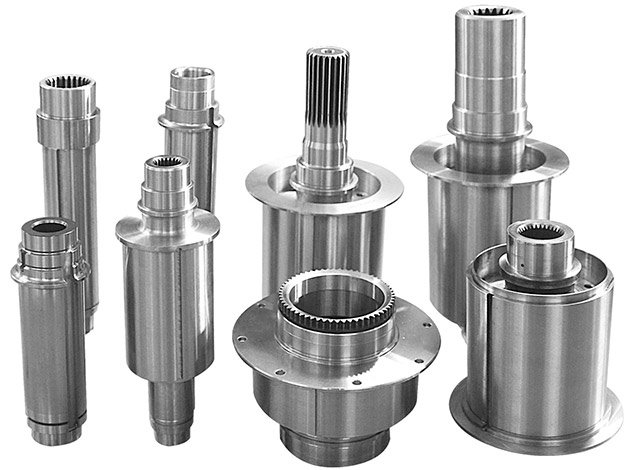
Gears, splined shafts, eccentric shafts, and crankshafts require coordinated control of geometry, surface finish, and runout. Large rotating parts are especially sensitive to imbalance and alignment error. Combining CNC machining with precision grinding and inspection enables a more complete manufacturing route than relying on a single process supplier.
5. Call to Action
Large-scale machining should be evaluated as a complete engineering and supply chain program, not only as a quoted machine-hour requirement. Gantry milling provides the rigidity and envelope needed for large structural workpieces, while crankshaft grinding delivers the geometric and surface control required for high-performance rotating components. Both depend on disciplined process planning, stable workholding, thermal management, inspection, traceability, and delivery coordination.
IndustryApex Technology, through IndustryApex CNC, works with global OEMs and Tier 1 suppliers that need a capable manufacturing partner for complex, high-value components. With more than 30 years of experience, ERP-supported production control, 3-axis to 5-axis CNC machining, EDM, precision grinding, and industrial ceramics, the company can support projects from manufacturability review through production and shipment.
Review your next large machining requirement with the IndustryApex Technology team through the Contact Us page. You can also explore the company’s broader CNC components manufacturing capabilities to identify an appropriate production route for your application.