- Shaft
- Molds&Tools
- Hydraulics And Pump
- Hair transplant needle
- Hydraulics And Pump
- Precision CNC Shaft Machining Manufacturer for High Performance Applications
- Energy Industry CNC Machining Parts Supplier
- Aerospace CNC Machining Parts Manufacturer
- Aerospace CNC Machining Parts Manufacturer
- Automotive & EV CNC Machining Parts Supplier for OEM and Tier 1
- Medical CNC Machining Parts Supplier for Precision Medical Devices
Titanium Implants: Challenges and Solutions in Medical CNC Machining


Titanium Implants: Challenges and Solutions in Medical CNC Machining
Executive Summary
Titanium implants occupy a demanding intersection of material science, precision engineering, regulatory compliance, and global supply-chain execution. Orthopedic screws, trauma plates, spinal fixation components, dental abutments, joint-replacement parts, and surgical-device elements must meet highly controlled dimensional, surface, cleanliness, and traceability requirements. A machining error that may be tolerable in general industrial production can become a major quality, patient-safety, or validation issue in medical manufacturing.
For global original equipment manufacturers and Tier 1 suppliers, the central challenge is not simply finding a machine shop that can cut titanium. It is establishing a qualified manufacturing partner that can reliably manage difficult titanium alloys, intricate geometries, lot-controlled raw material, process validation, inspection evidence, and predictable delivery. Medical CNC machining therefore requires a systems-level approach that connects engineering decisions with production controls and supply-chain governance.
Dixin Technology, operating through IndustryApex CNC, supports this requirement through precision manufacturing and ODM-oriented supply-chain integration. Its controlled manufacturing system combines more than 30 years of experience with ERP-based production management, 3-5 axis CNC machining, EDM, precision grinding, and industrial ceramics capabilities. This article examines the main barriers to machining titanium implants and the practical strategies used to improve quality, repeatability, throughput, and sourcing resilience.
Technical Deep Dive
Titanium remains a preferred implant material because it offers high strength-to-weight performance, excellent corrosion resistance, favorable biocompatibility, and a modulus of elasticity closer to bone than many stainless steels or cobalt-chromium alloys. Common medical grades include commercially pure titanium and titanium alloy Ti-6Al-4V ELI, selected according to the intended implant function, mechanical loading profile, and applicable material standard.
These advantages create corresponding machining difficulties. Titanium has relatively low thermal conductivity, so heat concentrates near the cutting zone instead of dissipating efficiently through the workpiece. This can accelerate tool wear, alter cutting-edge performance, and create a risk of thermal damage if cutting parameters or coolant delivery are poorly controlled. Titanium can also work harden, exhibit elastic recovery, and generate long, difficult-to-manage chips. Thin implant features and complex anatomically driven profiles are especially vulnerable to deflection and vibration.
Successful titanium implant machining begins with engineering for manufacturability. Before production starts, manufacturing engineers should review tolerance schemes, datum structures, wall thickness, thread forms, transition radii, and surface-finish requirements. Features that are technically possible but difficult to inspect or fixture can introduce disproportionate variation and cost. Early collaboration allows the OEM, product designer, and manufacturer to align tolerances with functional requirements rather than relying on unnecessarily restrictive specifications.
Tooling and cutting strategy are equally important. High-performance carbide tools, suitable coatings, optimized flute geometry, rigid workholding, and stable machine dynamics help control heat and preserve predictable tool life. Toolpaths should maintain consistent chip load wherever feasible, reduce abrupt directional changes, and prevent prolonged dwell that can harden the material or damage a surface. High-pressure, precisely directed coolant improves chip evacuation and reduces the likelihood of recutting chips. For high-value implant components, tool-life monitoring and scheduled replacement are often preferable to allowing a cutting tool to run until failure.
Complex implants may require simultaneous 5-axis machining to create freeform surfaces, angled holes, contoured interfaces, and undercut-adjacent features while minimizing repeated setups. Reducing setups can improve positional accuracy and lower handling risk, but it raises the importance of fixture design, machine calibration, CAM verification, and collision control. EDM can complement CNC machining when internal corners, narrow slots, fine geometries, or challenging access conditions exceed practical milling limits. Precision grinding provides a controlled method for critical diameters, sealing surfaces, mating profiles, and tight surface-finish requirements.
Surface integrity is a defining quality consideration. Implant surfaces may need to support bone integration, wear performance, cleanability, or assembly functionality. A drawing requirement for roughness alone may not fully communicate the functional intent. Manufacturers should evaluate burr formation, sharp-edge condition, residual stress, machining marks, contamination risk, and the compatibility of subsequent finishing processes. Deburring must be controlled rather than improvised, especially around threads, holes, and patient-contact edges. Cleaning and packaging processes should prevent residues, particulates, and mixed-material contamination from undermining an otherwise conforming machined part.
Quality planning must also be evidence-driven. Material certificates, incoming inspection, first-article inspection, in-process verification, calibrated measuring equipment, and final inspection records should be connected to each production lot. Coordinate measuring machines, optical measurement, thread gauges, surface roughness testing, and specialized functional gauges may all be necessary depending on the component. A robust inspection plan focuses on critical-to-quality characteristics and confirms that the measurement method is capable of verifying the specified tolerance.
For medical-device programs, traceability is not a paperwork afterthought. The manufacturing record should connect raw material heat or lot information, machining route, inspection results, nonconformance disposition, and shipment identity. ERP-supported process control helps maintain this relationship at scale, enabling faster containment when a quality question emerges and improving the discipline required for recurring production.
The ODM & Supply Chain Advantage
Medical OEMs often face a fragmented supplier landscape. One company may machine titanium, another may perform EDM, another may grind critical features, and separate vendors may manage finishing, inspection, or packaging. While specialization can be useful, the handoffs create schedule exposure, documentation gaps, inconsistent accountability, and higher coordination costs. For programs moving from prototype to pilot production and serial supply, those risks can delay validation and complicate change control.
Dixin Technology is positioned as a supply-chain integrator and ODM solution provider, helping OEM and Tier 1 teams coordinate the manufacturing path rather than managing disconnected processes independently. The objective is to create a controlled route from design review and material planning through machining, inspection, final delivery, and ongoing production support. This model is particularly valuable where titanium implants combine fine details, stringent tolerances, and multiple manufacturing technologies.
The manufacturing edge rests on a fully controlled precision manufacturing system supported by ERP management and more than 30 years of production experience. ERP visibility supports planning discipline across material availability, work orders, process routing, lot traceability, inspection status, and delivery commitments. It also gives sourcing teams a clearer basis for communicating lead times, responding to demand changes, and identifying constraints before they become shipment delays.
Dixin Technology’s technical capability spans 3-5 axis CNC machining, EDM, precision grinding, and industrial ceramics. This broader capability set matters because implant and instrument designs increasingly demand more than straightforward prismatic milling. A titanium implant may need multi-axis contouring and drilled or tapped features, while an associated surgical instrument may require precision-ground shafts, EDM-defined profiles, or wear-resistant ceramic components. Coordinating these processes under one manufacturing framework can reduce part transfers and preserve dimensional relationships between critical features.
For global OEMs, supplier qualification should assess both component capability and operational maturity. A capable partner should be able to discuss material availability, process windows, fixture concepts, inspection planning, capacity loading, packaging expectations, and export logistics with the same level of rigor applied to cutter selection. This is the difference between receiving individual parts and building a dependable production program.
An ODM-oriented engagement also creates value during development. Manufacturing feedback can identify features that increase cycle time without improving clinical function, opportunities to consolidate parts, alternative process routes, or inspection strategies that improve repeatability. Such feedback should be documented through disciplined engineering communication so that design changes, approved deviations, and production revisions remain controlled. The result is a more manufacturable component and a supply chain better prepared for regulated commercialization.
Industry Applications
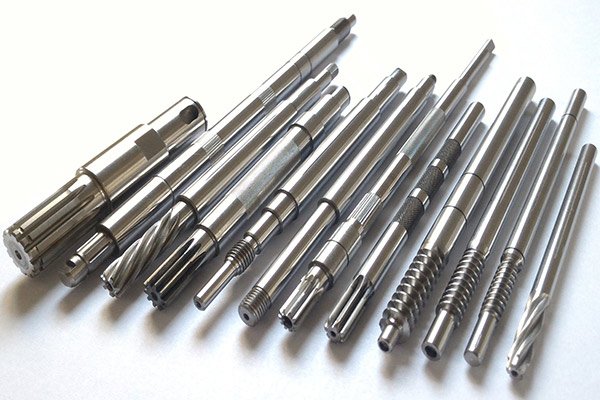
The most direct application is the production of medical components such as bone screws, trauma fixation plates, spinal connectors, dental implant components, instrument handles, surgical guides, and implantable device housings. Learn more about ISO-certified CNC machining for medical components, titanium implants, and surgical instruments. These products demand a blend of machining accuracy, burr control, stable surface finish, and rigorous documentation.
There are also meaningful adjacent applications in aerospace, fluid control, and advanced industrial equipment. Aerospace programs use titanium for structural and high-performance components where lightweight strength and corrosion resistance are essential. The same principles of heat management, multi-axis machining, process control, and traceability apply to titanium aerospace CNC machining and aircraft structural components, although the regulatory and functional requirements differ from medical applications.
Fluid-control systems also benefit from precision manufacturing practices developed for difficult materials and critical dimensions. Tight fits, sealing surfaces, valve features, and repeatable concentricity are common requirements in hydraulic pump parts and fluid-control components. Cross-industry manufacturing experience enables a supplier to apply proven process discipline while respecting the distinct material, quality, and validation needs of each market.
For procurement leaders, the application takeaway is clear: titanium implant sourcing should not be evaluated solely on unit price. Total program performance depends on yield, repeatability, inspection completeness, delivery reliability, engineering responsiveness, and the supplier’s ability to integrate specialized processes. A low initial quotation can become expensive when it produces unstable cycle times, repeated inspection failures, documentation rework, or unplanned supplier transfers.
Call to Action
Medical-device manufacturers and Tier 1 suppliers need titanium implant partners that understand both precision machining and the broader operational system required for controlled production. Dixin Technology provides ODM-oriented supply-chain integration, disciplined precision manufacturing, and multi-process capability for challenging titanium and high-precision component programs.
To discuss a titanium implant drawing package, prototype requirement, transfer program, or recurring production demand, contact Dixin Technology for a manufacturing and supply-chain review.